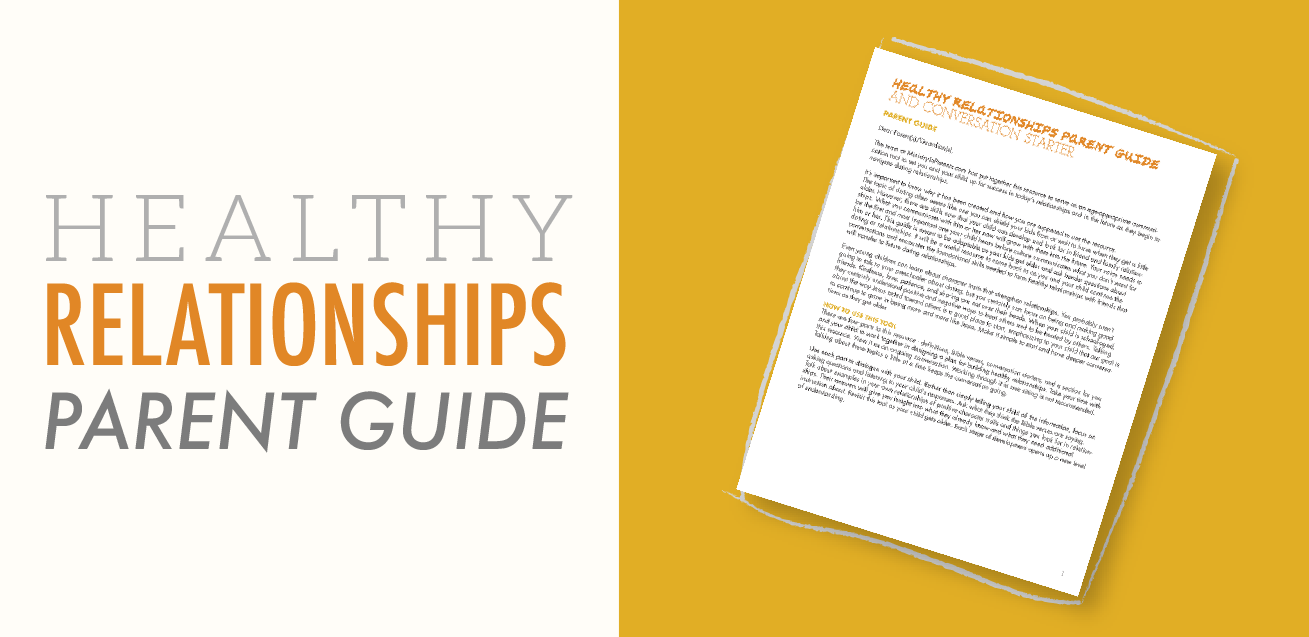

This Healthy Relationships Parent Guide and Conversation Starter is designed to help parents step into a conversation with their kids about what healthy relationships look like. Helping kids generally understand what healthy relationships look like will help them in their future dating choices.
Parent Guide
Dear Parent(s)/Guardian(s),
The team at MinistryToParents.com has put together this resource to serve as an age-appropriate communication tool to set you and your child up for success in today’s relationships and in the future as they begin to navigate dating relationships.
It’s important to know why it has been created and how you are supposed to use the resource.
The topic of dating often seems like one you can shield your kids from or wait to have when they get a little older. However, there are skills now that your child can develop and look for in friend and family relationships. What you communicate with him or her now will grow with them into the future. Your voice needs to be the first and most important one your child hears before culture communicates what you don’t want for him or her. This guide is meant to be adaptable as your kids get older and ask harder questions about dating or relationships. It will be a useful resource to come back to as you and your child continue the conversations and encounter the foundational skills needed to form healthy relationships with friends that will transfer to future dating relationships.
Even young children can learn about character traits that strengthen relationships. You probably aren’t going to talk to your preschooler about dating, but you certainly can focus on being and making good friends. Kindness, love, patience, and sharing are not over their heads. When your child is school-aged, they certainly understand positive and negative ways to treat others and to be treated by others. Talking about the way Jesus acted toward others is a good place to start, emphasizing to your child that our goal is to continue to grow in being more and more like Jesus. Make it simple to start and have deeper conversations as they get older.
How to Use This Tool
There are four parts to this resource – definitions, Bible verses, conversation starters, and a section for you and your child to work together in designing a plan for building healthy relationships. Take your time with this resource. View it as an ongoing conversation. Working through it in one sitting is not recommended. Talking about these topics a little at a time keeps the conversation going.
Use each part to dialogue with your child. Rather than simply telling your child all the information, focus on asking questions and listening to your child’s responses. Ask what they think the Bible verses are saying. Talk about examples in your own relationships of positive character traits and things you look for in relationships. Their answers will give you insight into what they already know and what they need additional instruction about. Revisit this tool as your child gets older. Each stage of development opens up a new level of understanding.
Definitions
Ask your child these questions and use the definitions to help you have further conversation.
What the Bible Says
This section is designed to help you and your child link character traits they can display and have reciprocated in relationships. We suggest you share one verse at a time. You can help your kids memorize some of these verses to help them develop good character traits in themselves and to look for in others. Pick a verse a week to focus on and use as a way for your child to identify some concrete ways he or she can display positive character traits throughout the week.
The Character Conversation
It’s very likely that your child knows the difference between good and bad character traits and how they affect relationships. First, ask your child the questions, and then share your own answers. Emphasize what good character and bad character can do in a friendship.
The Dating Conversation
Find out what your child knows about and thinks about dating. Let them share their answers with you, and then expand the conversation with your own thoughts about your child dating when it’s time. Be prepared that your younger child will say he or she doesn’t ever want to date. This is completely normal. As the answer changes, let it be an indication that it’s time to talk about dating in more concrete terms.
Building Healthy Relationships
This is the section where you work with your child to create a plan for being a positive friend and making good friends. Keep this handy to reflect on with your child. When relationship issues occur, and feelings have been hurt, use it to guide your child in addressing issues and making decisions about when to fix the relationship, when to set a boundary, and when to let the friendship go. Being able to reflect in this way will help your child with friendships and dating relationships as they grow up.
We are cheering you on as you tackle some big ideas with your kids. We hope that this resource provides building blocks to aid you in guiding your child in their relationships today and in the future.
Conversation Starter: Healthy Relationships & the Dating Conversation
What is a relationship?
A relationship is the way in which two people are connected. Examples are parent and child, teacher and student, friends, boyfriend and girlfriend, and husband and wife.
What is a boundary?
A boundary is the limits and rules we set in a relationship. They help us communicate what we will and won’t do with a friend. Healthy boundaries mean we can say “no” to negative things, like doing something that disobeys a parent, and “yes” to positive things, like helping others.
What is character?
Character is made up of behaviors and thoughts (negative or positive) that a person displays to God and others.
What is dating?
Dating is spending time talking and doing things with someone with whom you have romantic feelings.
What does the Bible have to say about character?
- 1 Corinthians 15:33 – Do not be misled: “Bad company corrupts good character.”
- Proverbs 22:24-25 – Do not make friends with a hot-tempered person, do not associate with one easily angered, or you may learn their ways and get yourself ensnared.
- 1 Timothy 6:11 – But you, man of God, flee from all this, and pursue righteousness, godliness, faith, love, endurance, and gentleness.
- Colossians 3:12 – Therefore, as God’s chosen people, holy and dearly loved, clothe yourselves with compassion, kindness, humility, gentleness, and patience.
- Romans 12:10 – Be devoted to one another in love. Honor one another above yourselves.
- Luke 6:31 – Do to others as you would have them do to you.
- Galatians 5:22-23 – But the fruit of the Spirit is love, joy, peace, forbearance, kindness, goodness, faithfulness, gentleness, and self-control. Against such things there is no law.
- 1 Corinthians 13:4-7 – Love is patient, love is kind. It does not envy, it does not boast, it is not proud. It does not dishonor others, it is not self-seeking, it is not easily angered, it keeps no record of wrongs. Love does not delight in evil but rejoices with the truth. It always protects, always trusts, always hopes, always perseveres.
- Ephesians 4:1-3 – Be completely humble and gentle; be patient, bearing with one another in love.
- Philippians 4:8 – Finally, brothers, whatever is true, whatever is honorable, whatever is just, whatever is pure, whatever is lovely, whatever is commendable, if there is any excellence, if there is anything worthy of praise, think about these things.
- 1 John 5:3a – In fact, this is love for God: to keep his commands.
The Character Conversation
- What things should you look for when making a new friend?
- How do you want your friends to treat you?
- What things can you do to be a good friend to others?
- What does it mean to be compassionate? Kind? Humble? Gentle? Patient?
- How does bad character hurt a relationship?
- Why does good character matter?
- Why are boundaries a good thing in a relationship?
The Dating Conversation
- What does it mean for two people to be dating?
- Why do you think people like to date?
- What kinds of things do people do on dates?
- When should someone be allowed to date?
- What kinds of rules should teenagers have for dating?
- What are some good things and bad things about dating?
- Do you want to be able to date when you’re old enough? Why or why not?
Building Healthy Relationships Now So I Can Build Healthy Relationships Later
I can show God I love Him by…

I can be a godly son/daughter by…
I can show my brother/sister I love them by…
I can be a good friend by…
Here are some things I want in a friend…
Here are some things I don’t want in a friend…
A boundary I need to set with friends is…
Write a prayer to the Lord asking Him to help you show godly character and have good relationships.

HERE’S A PREVIEW OF THE RESOURCE: