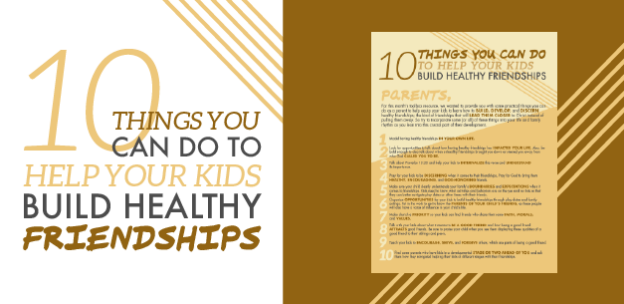
For this month’s toolbox resource, we wanted to provide you with some practical things you can do as a parent to help equip your kids to learn how to build, develop, and discern healthy friendships; the kind of friendships that will lead them closer to Christ instead of pulling them away. So try to incorporate some (or all) of these things into your life and family rhythm as you lean into this crucial part of their development.
Model having healthy friendships in your own life.
Look for opportunities to talk about how having healthy friendships has impacted your life. Also, be bold enough to also talk about when unhealthy friendships brought you down or steered you away from who God called you to be.
Talk about Proverbs 13:20 and help your kids to internalize this verse and understand its importance.
Pray for your kids to be discerning when it comes to their friendships. Pray for God to bring them healthy, encouraging, and God-honoring friends.
Make sure your child clearly understands your family’s boundaries and expectations when it comes to friendships. Kids need to know what activities and behaviors are on the yes and no lists so that they can better navigate play dates or other times with their friends.
Organize opportunities for your kids to build healthy friendships through play dates and family outings. Put in the work to get to know the parents of your child’s friends, as these people will also have a voice of influence in your child’s life.
Make church a priority so your kids can find friends who share their same faith, morals, and values.
Talk with your kids about what it means to be a good friend and how being a good friend attracts good friends. Be sure to praise your child when you see them displaying these qualities of a good friend to their siblings and peers.
Teach your kids to encourage, serve, and forgive others, which are parts of being a good friend.
Find some parents who have kids in a developmental stage or two ahead of you and ask them how they navigated helping their kids at different stages with their friendships.
Copy/ Paste this email into a browser and send it to parents.
Subject Line: Building Healthy Friendships
Dear Parents,
Let’s schedule a play date! That’s a phrase you have probably found yourself using at some point as your kids have continued to grow up. Have you ever paused to wonder why you work so hard to help them make friends with other kids? Maybe it’s because, deep down, you realize that the people whom your kids become friends with and those they surround themselves with will have a significant influence on the choices they make and will ultimately determine the direction and quality of their lives. So, you do whatever you can as a parent to help connect them with good potential friends because you want your kids to build healthy friendships. What you might not know is that as your kids get older, you still have the opportunity to influence and steer them toward healthy friendships; this will be true all along their journey to adulthood.
This month we are providing you with some excellent ideas, tools, resources, and, as always, a little extra encouragement that will help you start or take another step forward in an ongoing conversation with your kids about healthy friendships—what they look like and how to recognize the healthy from the unhealthy.
To watch this month’s Online Parenting Class video, click the link below.
Hang in there and know that we are in this together! We are always here for you if you need us.
Praying with you and for you as you lead at home.
Your friend,
[INSERT LEADER’S SIGNATURE HERE]
EMAIL 2
Copy/ Paste this email into a browser and send it to parents.
Subject Line: Good Friends: They Matter to Our Kids
Dear Parents,
As you think about the preferred future for your kids, there is one thing that will have the most significant impact when it comes to the path they will walk, the choices they will make, the direction their lives will go, and ultimately the quality of their lives. It’s their friends. I bet that you already know this to be true, but I’ll remind you just the same. The people whom your kids choose to be friends with, surround themselves with, and do life with will have a tremendous impact on the decisions they make, where they go in life, and how fulfilling their life will be. If we know that their choices in friends is going to have such a big impact on them, wouldn’t it make sense that we work really hard to help them figure out this part of life?
In this month’s blog article, you’ll learn some tools to help equip your child to recognize, value, and make good friends. Take a few minutes to check it out. You’ll be glad you did.
And don’t forget to check out this month’s Online Parenting Class video, where we explain the importance of leaning in and paying attention to the friendships your kids are building. We will also share with you some ways that you can leverage your influence as a parent to help your kids better navigate this crucial area of life.
Thank you for allowing us to partner with you as you lead your family. If you have any questions, please don’t hesitate to reach out.
In this alongside you,
[INSERT LEADER’S SIGNATURE HERE]
M2P April KIDS Parent Video Script “Building Healthy Friendships”
I remember when our son was in late elementary school, we had just moved to a new town, and we knew he was going to need some new friends. As we settled into a new school, new people, and a new routine, we started to meet families and get to know some other kids. There was this one group of boys who, you could tell, were kind of the “cool kids” of the elementary school (if there is such a thing). These kids were all athletes, like our son, and for a few years, I was kind of hoping that he would become a part of their crew. Well, he could never quite break in, and, if I’m honest, he didn’t even really try. Seeing where all of these kids are today, I’m actually really thankful that, when it comes to friendships, he went a different route. And the route he went started at church.
You see, during that season of life, we were getting really plugged in at our new church, and that became the place where he began to develop good, healthy, God-centered friendships that are still critical to him today, years later. As parents, we all want for our kids to build solid friendships that will help them grow, develop, and enjoy their childhood years. Part of what we need to do is pay attention to the friendships our kids are developing and do whatever we can to gently steer them into friendships that will be good for them. Deep down, I knew that the “cool kid” crew probably wasn’t the best group for my son to be a part of, but I really wanted him to have some good friends. When I saw him developing the types of friendships I really wanted him to have at church, I pushed him in that direction.
As parents, you have the opportunity to dial certain relationships in and other ones out. Now we can’t completely control who our kids are friends with, and I don’t think we should try. But we can put our kids in environments with people we want them grow closer to. Proximity matters, and with kids, proximity often matters most. Surround your kids with other kids you WANT them to build relationships with. Have families over, do special events together, make church on Sunday and church events a priority for your family. I promise you the leaders at your church want to create environments where kids can build solid, healthy relationships based around a relationship with God, and those are the kinds of friendships you want your kids to have.
Do your best to pay attention to the friendships your kids are building. As you are moving through life with your kids, listen for who they talk about and watch who they gravitate towards when in social situations. And then try to determine if the friendships they are developing are giving them life and building them up … or draining them and pulling them down. Part of what we want to do as parents is help our kids learn how to discern what friendships are good for them and what friendships are bad for them, even if they enjoy them. Years ago, I learned a phrase from Andy Stanley, and I started using it with my kids. I’ve used it so much that they know it and will often recite it back to me when we are having conversations about friendships. It says this: Your friends will determine the quality and direction of your life. Let me say it again: Your friends will determine the quality and direction of your life. As adults, we know this to be true. It’s really just another way to say what God says in Proverbs 13:20: “He who walks with the wise grows wise, but a companion of fools suffers harm.”
What if you started embedding both of those phrases into the hearts and minds of your kids. What if you helped them see that the company they keep and the friends they choose not only has an impact on their lives today but it has an impact on their lives for a long time to come.
Here’s the last thing I’ll say. As parents, we should be praying for our kids in so many ways, and one of the ways we can pray for them is in the area of friendships. Pray that your kids will build healthy relationships that will encourage them and build them up. Pray that they will have friends who share their faith, morals, and values. Pray that they can be growing in their relationship with God through their relationships with their friends. Pray that you can be discerning and wise as you seek to help them develop the friendships they are going to need as they grow and develop.
So, when it comes to the friendships your kids are building, remember that who they connect with and who they build friendships REALLY matters and, as their parent, you have the opportunity … and maybe even responsibility … to help them build healthy friendships that will give them what they need.
It’s that time of year when many of us are a bit distracted by this little thing called “March Madness.” Filling out a bracket and pulling for your team can be a lot of fun. It can also eventually produce a stay in the heartbreak hotel when your team finally loses. If you have no idea what I’m talking about or don’t speak “sports ball,” no problem. Just know that the madness is real, and it goes far beyond march and a basketball tournament.
There is a madness to our world that can pull us down, redirect our attention, and derail us from living the life God has for us. As children’s ministry leaders, we have the unique opportunity to lead ourselves, our volunteers, the kids, and the families in our church in a different direction. We can either get caught up in the madness, or we can attempt (with God’s help) to rise above it. This month’s M2P resources are designed to help you address this madness by providing you with some “conversational layups” to get the ball moving with the parents within your ministry’s sphere of influence. But M2P also wants to make sure that we help you, as a children’s ministry leader, to rise above the rim and the madness yourself as you lead the parents, families, kids, and volunteers within your span of care in a healthy direction as they navigate the world.
This month we’re hoping families can take a deep breath and enjoy a little time together with their kids while using our “Family Fun Bracket.” Families will be able to learn what “wins” for each person while maybe learning a little more about each other along the way. Sometimes we just need to sit down together as a family, go through a fun exercise, chat a little, and hopefully laugh a lot. But be careful; it’s possible that some of those March Madness competitive juices might get flowing, and somebody might want to stand up and “box out” for something in their bracket. Either way, it’s an opportunity to engage in “March Madness” at home. . . and you’re your grade-schooler doesn’t even have to be able to dunk.
HOW TO USE IT
Download the “Family Fun Bracket” and post it on your website.
Email parents a copy of the bracket or a link to it and encourage them to set aside some time to have a fun time with it.
Print copies of the bracket for parents to grab at church.
To download, click HERE for youth and HERE for kids.
This month’s coaching video encourages you to take a look at yourself and your children’s ministry as you seek to march through the madness of the world and lead the parents, families, kids, and volunteers within your span of care. Let’s be honest; there’s always a lot going on both within your own life and heart, not to mention all that’s going on inside your church. As children’s ministry leaders, we have to navigate crazy schedules, plan events, juggle family, deal with church politics, and process all the information that comes our way. If we’re not careful, our hearts can grow cold, and we’ll move farther and farther away from having a real relationship with the God we serve. In this month of March Madness, we hope you’ll recognize the importance of evaluating how you are doing and think about whether you are in a healthy place where you can lead the parents, families, kids, and volunteers in your church to walk away from the madness as they seek to live the life God has called them to live.
As we seek to encourage parents this month, we point out that we are all living in a type of madness that can lead our family away from having a healthy pace and perspective on life. Busy schedules, angst about the future, and a fixation on political and cultural events can spiral us all down. Our hope and prayer is for parents to rise above it all and live their lives with a sense of peace that will spill out onto/into their kids. If parents can learn how to navigate the madness in a healthy way, they have the potential to then lead their kids to do the same. This month’s Online Parenting Class offers some practical suggestions and points parents to Scripture that can hopefully inspire them to point their families in a different direction.
As you hopefully know, we’re always aiming to help you grow in your faith, personal development, and ministry leadership. If we’re honest, we would all admit that we can easily get derailed in all three of those areas if we don’t pay close and consistent attention. We live in a world that produces a type of madness that can overwhelm us. Life happens, things pile up, we feel ministry pressure, and it can all spiral out of control before we know it. In this month’s coaching video, we want to offer you and your children’s ministry volunteers some encouragement from Scripture, and practical ideas about things you can do to both maintain a healthy perspective yourself and lead the parents in your church in the same direction. Instead of marching towards the madness (see what we did there ◡̈), we have the opportunity to lead the people in our scope of care in a different direction where we live in a much more peaceful place. We encourage you and your ministry volunteers to join us as we think through what it might mean to live not “in” but “above” the madness
Click the image above to watch the video or click HERE!
This “Family Fun Bracket” is designed to help parents lead their kids and the entire family in a little fun, hoping to have some light-hearted conversations and debates.
Family Fun Bracket
It’s tournament time, and you and your family can fill out a different kind of bracket this year. Each family member can decide which item would “win” in their mind and move that item along in the tournament. Each person will get a winner for their bracket. Do this exercise together, talking about why you picked each item along the way. It’s just a way for your family to make some choices (and there are NO wrong answers), talk about why you chose what you did, and hopefully laugh a little along the way. And you just might learn something about each other.
Copy/ Paste this email into a browser and send it to parents.
Subject Line: The Madness of Spring
Dear Parents,
As we begin to move into spring and all that it brings, we’d like to encourage you to resist succumbing to a certain chaos that we all feel. Now sure, there’s a March Madness that you might get into (if you’re a sports fan), but we need to do everything we can to steer our kids away from developing patterns of living in a madness that will lead them to a life that is far less than the one God wants for them. You know what I mean; busy schedules, school, sports, pressure to achieve, and developing fears all have a way of taking over our kids’ thoughts. As parents, you have the opportunity to model to your kids how to live differently in the world and teach them the principles and skills that will help them build a healthy perspective on how to live. Instead of marching through the madness, we can learn to develop a peace that comes from God and will guard our hearts. If we develop this peace ourselves, we just might be able to pass it on to our kids.
During this month of March Madness, we want to provide you with some ideas, tools, resources, and a slam dunk of encouragement to equip you to help your kids build a healthy perspective on how to live outside of the madness.
To watch this month’s Online Parenting Class video, click the link below.
Thank you for allowing us to team up with you as you lead your family. If you have any questions, please don’t hesitate to reach out.
Cheering you on,
[INSERT LEADER’S SIGNATURE HERE]
EMAIL 2
Copy/ Paste this email into a browser and send it to parents.
Subject Line: Marching Away from the Madness
Dear Parents,
If you had to rate how crazy your world is right now, what would you say? What about your kid’s world? Your answers likely revolve around how busy your family is, how much you pay attention to current events, and how good your relationships are. We can all point to parts of our lives that can make us believe we’re going mad, but there is hope. There is more. There is a different way of life that we can all step into if we will simply stop focusing on and joining in on all of the noise, chaos, and madness; stop letting it lead our thoughts and our actions.
Check out this month’s blog article that might just give you a different perspective on the noise you’re experiencing, as well as some tips on what you can do to decrease all the noise and distractions “dinging” for your attention. And if you haven’t watched this month’s encouraging Online Parenting Class video, you still have time. To read the blog article or watch the video, click on the links below.
We are in this together! Let us know if there is ever anything we can do for you or your family.
Praying for you as you lead at home,
[ INSERT LEADER’S SIGNATURE HERE ]
M2P March KIDS Parent Video Script “Peace In The Madness”
Often when I have the chance to talk to parents, I have a couple of assumptions. Now, I know what assumptions can sometimes do to us, but we’re not gonna go there .
I assume that we all want to be great parents. We all want to do everything we can to offer our kids what they need as they grow up. I assume that we all want to have a healthy, sustainable pace of life that doesn’t overwhelm us and doesn’t suck the life out of our family. I assume that we all want for our kids to develop the skills they need to have a healthy, sustainable pace of life that doesn’t overwhelm them in the future. I assume that we all want for our kids to grow up with a real faith that makes a difference in their lives.
We’re in a month that is affectionately referred to as “March Madness” by anyone who follows college basketball. It’s a month where we get to watch this basketball tournament that often takes crazy twists and turns and can be kind of chaotic. And we love it … unless our team is supposed to win, and they don’t, but that’s another story.
We love the madness. But you see, it’s not just the tournament and the month of March that are madness … our lives can sometimes spiral into a different kind of madness that leads us away from all of the things I started our conversation with. We lose focus of being great parents and offering our kids what they really need. We develop an unhealthy pace of life that drains us and leads us, as adults, to a place of fear and worry, and anxiety. We fail to teach our kids that they don’t have to live in the madness and they don’t have to settle for a chaotic pace of life and a cluttered brain and heart.
And I think all of this madness and the noise around us all is so loud that it’s REALLY hard for our faith and our kids’ faith to take root and grow. Because I know for me, and hopefully for you, the ultimate goal is for our kids to know and love Jesus and live from a peace that only comes from Him.
If you have figured out how to live in a way that you can effectively go through life, but block out the madness, then more power to you. Keep it up, and send us some tips on how you’ve been able to do that. But if you struggle with all of the madness, we would encourage you to do a few things. First, Take some time to sit down with a piece of paper or a journal and a pen. Write down what parts of the madness are getting to you. Part of any attempt to change is identifying where you are and being honest about the current state of things. Second, find someone who you can talk to about this. Maybe it’s your spouse; maybe it needs to be a close friend or possibly a pastor or someone at your church. Whoever it is, have a conversation! We are not meant to do life alone, so just ask someone to sit with you and hear about what’s going on in your heart. They don’t have to solve anything; they can just be in it with you. And finally, spend some time asking God to show you how things can change. Prayer is powerful, and even though God doesn’t always take things away or make things smooth, He is always with us, and that matters.
Philippians 4:6-7. It says, “Do not be anxious about anything, but in every situation, by prayer and petition, with thanksgiving, present your requests to God. And the peace of God, which transcends all understanding, will guard your hearts and your minds in Christ Jesus.”
God doesn’t want us or our kids to live in the madness. He wants us to live in the peace that He offers. And if we can learn to do that, we can step more into being the parents we all want to be and the parents our kids need us to be.
As a kid, did you ever receive a cute little Valentine’s card from someone in your class or school? Did you ever have to “check ‘yes’ or ‘no’” to answer the “Will you go with me” question? OK, maybe you didn’t have either of those experiences, but we know that you did (at some point) start thinking about this thing called “dating.” We know that ideas about this topic are coming up earlier and earlier in the lives of our kids, and as children’s ministry leaders, we have to equip the church and parents we serve to step up and engage in the conversation. Since February is the month of love, it’s also the time of the year when many ministries wade into the topic at church and try to encourage kids to move toward healthy relationships. This provides you, as a children’s ministry leader, with the perfect opportunity to engage parents and better equip them to lead their kids at home as they navigate the often awkward and sometimes comical conversations around this important topic. So, whether the topic is kissing or the cooties, this month’s M2P resources are designed to provide you (and parents) with ideas and resources that will help frame these critical relationship conversations that we all need to be having with our kids.
For more on this topic, don’t forget to check out the blog articles, coaching video, online parenting class video, toolbox item, and the latest episode of the M2P Podcast. Remember that we are here to serve you and to help you serve parents, so let us know if there is ever anything we can do for you or your ministry.
With love, some candy hearts, and a box of chocolates,
The M2P Team
WHAT IS IT?
This “Parent Guide and Conversation Starter” is designed with thoughts, definitions, Bible references, and questions that were created to help the parent(s)/guardian(s) start an age-appropriate conversation about relationships and dating with their kids. This resource provides parents with a starting point for an ongoing conversation and one that they can come back to and adjust as needed by utilizing this adaptable toolbox resource as their kids get older and the questions get harder.
HOW TO USE IT
Download the toolbox resource. Post the explanation and link to it on your website.
Email parents a copy of the toolbox resource or a link to it and encourage them to set aside some time to work through it and begin having some open age-appropriate conversations with their kids.
Print copies of the toolbox resource for parents to grab at church.
To download, click HERE for youth and HERE for kids.
Since February is the month of love, it’s also the time of the year when many ministries tip-toe into the waters of the love and relationships topic at church and try to at least acknowledge the heart-shaped elephant in the room. Valentine’s Day and all that goes with it is just another reminder of how obsessed with love, sex, and dating our culture has become. Our kids are no doubt getting a collective earful/eyeful through music, movies, social media, commercials, and even just looking around. They are laying the foundations and building upon it what they believe about relationships, dating, and relational/physical boundaries. This month’s coaching videos give you some tips on how to weigh into this important topic as a children’s ministry leader. It’s a conversation that will never go away, one that we shouldn’t shy away from as children’s ministry leaders, and one we need to be having inside the local church. The kids in our churches and families are building a dating, relational, and sexual ethic, and we have the opportunity (and the obligation) to help shape what they believe.
In this month’s Online Parenting Class, we lean in and really challenge the parent(s)/guardian(s) in your ministry to make sure they are engaging their kids in conversations about the age-old topics of relationships, dating, and relational/physical boundaries. Often, as parents, we shy away from these difficult and taboo conversations while our kids are learning and picking up their cues on these things from peers, culture, social media, and the entertainment industry. But, if we want our children to have Godly perspectives, healthy relational/physical boundaries, and make wise choices in this area of life, then we have to be the ones to speak truth to them and lead them in that direction. So, these videos will offer parents some practical suggestions on how to engage in these conversations with their kids in a good and healthy way.
During the month of February, let’s take some time as children’s ministry leaders to acknowledge this month’s elephants in the room—Love, Relationships, and Dating (and maybe even sex). Valentine’s Day and the onslaught of media, eye candy, and actual candy that comes with it tend to consume our culture. The kids we are responsible for leading are, no doubt, already soaking everything in and using that to lay a foundation for what they believe about relationships, dating (and yes, even sex one day). The parents we are responsible for equipping are often too paralyzed to enter into these conversations with their kids or too naive to think they need to yet. That’s why we are taking the opportunity with this month’s coaching video to provide you with some tips on how to handle this important topic as a children’s ministry leader. And it all starts with helping the kids in our ministries understand what healthy relationships look like. How kids learn to handle the key relationships in their lives will chart their course with relationships (even romantic ones) for years to come. We have the opportunity to help shape what they believe and to help their parents be better equipped to step into these conversations in healthy and helpful ways.
Click the image above to watch the video or click HERE!
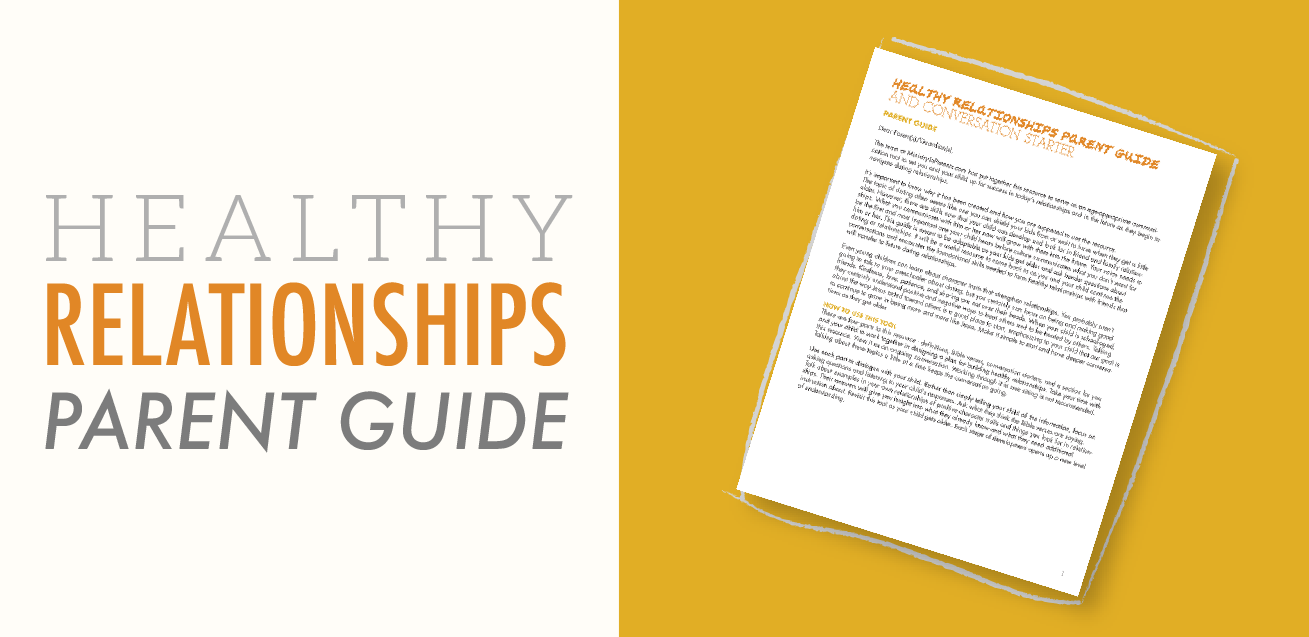
This Healthy Relationships Parent Guide and Conversation Starter is designed to help parents step into a conversation with their kids about what healthy relationships look like. Helping kids generally understand what healthy relationships look like will help them in their future dating choices.
Parent Guide
Dear Parent(s)/Guardian(s),
The team at MinistryToParents.com has put together this resource to serve as an age-appropriate communication tool to set you and your child up for success in today’s relationships and in the future as they begin to navigate dating relationships.
It’s important to know why it has been created and how you are supposed to use the resource.
The topic of dating often seems like one you can shield your kids from or wait to have when they get a little older. However, there are skills now that your child can develop and look for in friend and family relationships. What you communicate with him or her now will grow with them into the future. Your voice needs to be the first and most important one your child hears before culture communicates what you don’t want for him or her. This guide is meant to be adaptable as your kids get older and ask harder questions about dating or relationships. It will be a useful resource to come back to as you and your child continue the conversations and encounter the foundational skills needed to form healthy relationships with friends that will transfer to future dating relationships.
Even young children can learn about character traits that strengthen relationships. You probably aren’t going to talk to your preschooler about dating, but you certainly can focus on being and making good friends. Kindness, love, patience, and sharing are not over their heads. When your child is school-aged, they certainly understand positive and negative ways to treat others and to be treated by others. Talking about the way Jesus acted toward others is a good place to start, emphasizing to your child that our goal is to continue to grow in being more and more like Jesus. Make it simple to start and have deeper conversations as they get older.
How to Use This Tool
There are four parts to this resource – definitions, Bible verses, conversation starters, and a section for you and your child to work together in designing a plan for building healthy relationships. Take your time with this resource. View it as an ongoing conversation. Working through it in one sitting is not recommended. Talking about these topics a little at a time keeps the conversation going.
Use each part to dialogue with your child. Rather than simply telling your child all the information, focus on asking questions and listening to your child’s responses. Ask what they think the Bible verses are saying. Talk about examples in your own relationships of positive character traits and things you look for in relationships. Their answers will give you insight into what they already know and what they need additional instruction about. Revisit this tool as your child gets older. Each stage of development opens up a new level of understanding.
Definitions
Ask your child these questions and use the definitions to help you have further conversation.
What the Bible Says
This section is designed to help you and your child link character traits they can display and have reciprocated in relationships. We suggest you share one verse at a time. You can help your kids memorize some of these verses to help them develop good character traits in themselves and to look for in others. Pick a verse a week to focus on and use as a way for your child to identify some concrete ways he or she can display positive character traits throughout the week.
The Character Conversation
It’s very likely that your child knows the difference between good and bad character traits and how they affect relationships. First, ask your child the questions, and then share your own answers. Emphasize what good character and bad character can do in a friendship.
The Dating Conversation
Find out what your child knows about and thinks about dating. Let them share their answers with you, and then expand the conversation with your own thoughts about your child dating when it’s time. Be prepared that your younger child will say he or she doesn’t ever want to date. This is completely normal. As the answer changes, let it be an indication that it’s time to talk about dating in more concrete terms.
Building Healthy Relationships
This is the section where you work with your child to create a plan for being a positive friend and making good friends. Keep this handy to reflect on with your child. When relationship issues occur, and feelings have been hurt, use it to guide your child in addressing issues and making decisions about when to fix the relationship, when to set a boundary, and when to let the friendship go. Being able to reflect in this way will help your child with friendships and dating relationships as they grow up.
We are cheering you on as you tackle some big ideas with your kids. We hope that this resource provides building blocks to aid you in guiding your child in their relationships today and in the future.
Conversation Starter: Healthy Relationships & the Dating Conversation
What is a relationship?
A relationship is the way in which two people are connected. Examples are parent and child, teacher and student, friends, boyfriend and girlfriend, and husband and wife.
What is a boundary?
A boundary is the limits and rules we set in a relationship. They help us communicate what we will and won’t do with a friend. Healthy boundaries mean we can say “no” to negative things, like doing something that disobeys a parent, and “yes” to positive things, like helping others.
What is character?
Character is made up of behaviors and thoughts (negative or positive) that a person displays to God and others.
What is dating?
Dating is spending time talking and doing things with someone with whom you have romantic feelings.
What does the Bible have to say about character?
1 Corinthians 15:33 – Do not be misled: “Bad company corrupts good character.”
Proverbs 22:24-25 – Do not make friends with a hot-tempered person, do not associate with one easily angered, or you may learn their ways and get yourself ensnared.
1 Timothy 6:11 – But you, man of God, flee from all this, and pursue righteousness, godliness, faith, love, endurance, and gentleness.
Colossians 3:12 – Therefore, as God’s chosen people, holy and dearly loved, clothe yourselves with compassion, kindness, humility, gentleness, and patience.
Romans 12:10 – Be devoted to one another in love. Honor one another above yourselves.
Luke 6:31 – Do to others as you would have them do to you.
Galatians 5:22-23 – But the fruit of the Spirit is love, joy, peace, forbearance, kindness, goodness, faithfulness, gentleness, and self-control. Against such things there is no law.
1 Corinthians 13:4-7 – Love is patient, love is kind. It does not envy, it does not boast, it is not proud. It does not dishonor others, it is not self-seeking, it is not easily angered, it keeps no record of wrongs. Love does not delight in evil but rejoices with the truth. It always protects, always trusts, always hopes, always perseveres.
Ephesians 4:1-3 – Be completely humble and gentle; be patient, bearing with one another in love.
Philippians 4:8 – Finally, brothers, whatever is true, whatever is honorable, whatever is just, whatever is pure, whatever is lovely, whatever is commendable, if there is any excellence, if there is anything worthy of praise, think about these things.
1 John 5:3a – In fact, this is love for God: to keep his commands.
The Character Conversation
What things should you look for when making a new friend?
How do you want your friends to treat you?
What things can you do to be a good friend to others?
What does it mean to be compassionate? Kind? Humble? Gentle? Patient?
How does bad character hurt a relationship?
Why does good character matter?
Why are boundaries a good thing in a relationship?
The Dating Conversation
What does it mean for two people to be dating?
Why do you think people like to date?
What kinds of things do people do on dates?
When should someone be allowed to date?
What kinds of rules should teenagers have for dating?
What are some good things and bad things about dating?
Do you want to be able to date when you’re old enough? Why or why not?
Building Healthy Relationships Now So I Can Build Healthy Relationships Later
I can show God I love Him by…
I can be a godly son/daughter by…
I can show my brother/sister I love them by…
I can be a good friend by…
Here are some things I want in a friend…
Here are some things I don’t want in a friend…
A boundary I need to set with friends is…
Write a prayer to the Lord asking Him to help you show godly character and have good relationships.
Copy/ Paste this email into a browser and send it to parents.
Subject Line: Kids and Dating: Pay Attention
Dear Parents,
My guess is that there are a lot of things you think and worry about when it comes to your little ones. You think about their health and well-being. You are concerned with their physical, mental, and spiritual development and how they will grow in the next several years. I would also guess that you don’t spend as much time during this phase thinking about their dating life. Sure, you might be praying for their future spouse, but are you doing anything intentionally now to help set up your kids for a successful dating life? This month we want to provide you with some excellent ideas, tools, resources, and a little needed encouragement that will help you start an ongoing conversation with your kids about relationships and dating in an age-appropriate way and better equip you to navigate these conversations along the way.
To watch this month’s Online Parenting Class video, click the link below.
Thank you for allowing us to partner with you as you lead your family. If you have any questions, please don’t hesitate to reach out.
In this alongside you,
[INSERT LEADER’S SIGNATURE HERE]
EMAIL 2
Copy/ Paste this email into a browser and send it to parents.
Subject Line: More Than “The Talk”
Dear Parents,
Your little ones have a lot going on. They are growing and developing in so many ways, and it’s a lot of fun to watch. Before you know it, they’ll be taking an interest in that someone special and making decisions about relationships, boyfriends, girlfriends, and dating. I know that it seems eons away, but if you don’t open this conversation now, then you are rolling the dice on getting caught off guard with these issues and conversations later. The stakes are just too high and your kids’ futures are much too precious to risk. So, this month we want to provide you with some ideas, tools, resources, and some much-needed encouragement that we hope will help you as a parent be better equipped to navigate leading your kids through these critical areas of life.
In this month’s blog article, you’ll discover some practical tips for laying a foundation with your kids in an age-appropriate way now so that they can engage in healthy relationships in the future. Take a few minutes to check it out. You’ll be glad you did.
And don’t forget to check out this month’s Online Parenting Class video, where we give you some thoughts and ideas on why it’s never too soon to open an ongoing conversation about relationships with your kids.
Hang in there and know that we are in this together! We are always here for you if you need us.
Praying with you and for you as you lead at home.
[ INSERT LEADER’S SIGNATURE HERE ]
Video Script
This month we’re talking about dating. And you’re probably wondering if you have the correct parenting video! After all, isn’t dating a teen topic? Well, yes and no. Teens are the ones going on dates, so why do we need to talk about this now while your children are young? Because it matters. One of the goals of parenting is to keep the end game in mind. Who do you want your kids to be as they grow into adulthood? What characteristics do you want to instill in them before they leave your nest? Looking ahead helps focus your perspective on how to parent along the way.
You should be prepared that some children start to take an interest in the opposite sex earlier than you’d expect. In 2021, the American Academy of Pediatrics said kids start dating at an average age of 12 and a half for girls and 13 and a half for boys. If that’s the average, that means kids also start dating at younger ages. Kids’ access to social media, whether on their own devices or on a friend’s, as well as television shows and movies depicting young relationships, present the idea of dating early, and it may not be what you want for your children. In my experience with middle to late elementary grades, I’ve seen kids as young as 3rd grade begin writing “love notes” and pairing off. They talk about having a boyfriend or girlfriend. These relationships are often benign, but it does indicate a need to have conversations early before their ideas about boy/girl relationships are fully developed based on what they hear and observe.
Young boyfriend/girlfriend situations are problematic. Parents respond in different ways. You can talk about what dating is, when it might be appropriate to start dating, and most importantly, how you feel about dating through a God-shaped lens. Or you can look at these relationships as cute, going so far as to meet the other child’s parents, and take the kids to movies or other activities so they can go on an actual date. However, when you encourage the relationships of younger children, you are placing them in a position they are not yet ready for. These early relationships need to be handled carefully. Younger kids are at a stage of development where they aren’t prepared for the emotional aspects of dating, especially defining self based on what a person you care about thinks and heartbreak when the relationship is over.
It’s not too soon to begin thinking about what your guidelines are going to be. It’s far easier to set expectations before you’re in the position where your child wants to date than it is to make up the rules on the spot. Sooner or later, your child will ask you about dating. It may be curiosity questions when they’re younger or an “I want to date” request later. It’s better to be prepared ahead of time and teach your kids the values and guidelines set in your family along the way than it is to put the brakes on when you’re in the thick of it.
So what should you as a parent of younger children need to consider?
Have conversations with your spouse about your beliefs and guidelines for dating. If you are a single parent, talk with parents of younger children and process this topic together. All parents can benefit from seeking out those who are in the midst of the dating years with their kids. Gather information from them about things they’re glad they decided upon and things they wish they would have done differently. It’s never too early to begin to define what dating will look like in your home and start talking with your kids about it as they grow up. You and your children will be better prepared when the time comes.
Here are a few questions for you to think about in these conversations:
Why do people date? Is it purely for the purpose of looking for a spouse, is it a rite of passage, or is it to learn about navigating relationships?
What are your guidelines going to be?
Will you set a certain age to begin dating? Or will you use your child’s developmental ability to handle the emotional and physical side of dating?
What do you think about group dating as opposed to one-on-one dates?
How will you set boundaries like curfews, what are appropriate places to go on dates, and age differences?
What should your kids look for in a boyfriend/girlfriend? What traits are important? This is a question you can actually ask your children. With younger kids, some answers may be funny, but they can also be insightful. This conversation should be a regular thing as your child grows up.
It’s hard to imagine your younger child ever dating, but the day will come. The more time you spend now preparing for the future, the more you will be glad you did when you reach that stage of parenting.