Author Archives: M2P

Huddle Up: A Family Conversation About Faith And Sports

TO PARENTS & GUARDIANS

We all know that sports are a big part of our culture, and they may have a big influence on your kid(s) and your family’s time, calendar, and resources. Sports can be fun, exciting, and life-giving while also being difficult, disappointing, and emotionally defeating. If we aren’t careful, we can promote or allow our kids to experience unrealistic expectations, feel unnecessary pressure, have a misplaced sense of identity, live out our own dreams/perceived shortcomings through our kids, or allow sports to dominate our family calendar. Our job as parents is NOT to push our kids to be the best they can be in sports but to use sports as a vehicle to help them become the men or women God has created them to be.

If you want your kid(s) to grow up and be healthy (physically and spiritually), you need to carefully consider the perspective you have on sports, the perspective you are teaching our kid(s), and begin to make family decisions that lead your kid(s) in a direction that will put sports in its proper place in their lives.

This resource, entitled Huddle Up, will give you an opportunity to have a little fun with your kids as you talk together about the role sports play in your family’s life, how faith can integrate with sports, and encourage your kids to grow in their faith through sports while also living out that faith on the field of competition.

Learning how to keep a healthy perspective is really important, so take some time to “huddle up” as a family and talk about it!

INSTRUCTIONS

Print out the attached sheet and cut it in half. Give the “Questions for Kids to Ask Parents” half to your kid(s), and you hold onto the “Questions for Parents to Ask Kids” half yourself. Have your kid(s) start by asking you question one and have some fun answering it. Then, it’s your turn to ask your kid(s) question one and go back and forth through the rest of the questions from there.

After you have finished answering all the questions, take some time to read Hebrews 12:1-2, and talk about what those verses means to you. Ask your kid(s) how you can pray for them as they play sports. Take a moment to pray together.

Questions for Kids to Ask Parents

  1. What was your favorite sport to play growing up and why?
  2. What sport were you the worst at?
  3. What is your favorite sports memory from when you were playing?
  4. What is the funniest sports memory from when you were playing?
  5. What was your biggest fail, embarrassing incident, or frustrating moment when you were playing? How did you recover or handle it?
  6. Who is your favorite athlete and why?
  7. What’s the most memorable sporting event you’ve ever attended?
  8. On a scale of 1-10, how important is sports in your life and why?
  9. What was the biggest obstacle you had to overcome during sports and what did you learn from it?
  10. Was faith a part of your sports journey and how?
  11. What’s the biggest lesson you learned through playing sports?
  12. How do you think that I, as your child, can grow in my faith through sports?
  13. How do you think that I can live out my faith boldly and without compromise while playing sports?

Questions for Parents to Ask Kids

  1. What’s your favorite sport to play and why?
  2. What is your favorite sport to watch and why? What’s your favorite sports team to cheer for and why?
  3. Who is your favorite athlete and why?
  4. Do you think this person is a follower or Jesus? Do they show it while playing?
  5. Can you think of any athlete who does follow Jesus? What do they do to live out their faith boldly and without compromise while playing their sport?
  6. What is your favorite sports memory so far?
  7. What is the funniest sports memory so far?
  8. What do you think has been your biggest sports fail so far? How did you recover or handle it?
  9. Do you feel like sports has an impact on your faith one way or another and, if so, how?
  10. Do you feel like playing sports helps you grow in your faith or pulls you away from your faith?
  11. What are some things you can do to grow in your faith during your busy sports season?
  12. How can you use the gift of your athletic ability to glorify God?
  13. How do you think that you can live out your faith boldly and without compromise while playing sports?


HERE’S A PREVIEW OF THE RESOURCE:

Helping Your Child Navigate Life, Sports, And Spiritual Growth

EMAIL 1

Copy/ Paste this email into a browser and send it to parents.

Subject Line: Navigating Life and Our Kid’s Sports

Dear Parents,

For many of you, your life and family calendar are probably filled with carting your kid(s) around to practices, games, tournaments, and matches of all different types. It can be a lot of fun but, if we’re honest, it can be exhausting too. As a parent, you may need to take a little time to evaluate what a life overrun with sports is doing to your kid(s), their development, and their faith.

If your family is into sports or you think that someday they might be, this month’s resources for parents will help you better lead your family as you navigate all the things that come with being involved in, when it comes to your kid’s athletics. As your Children’s Ministry leaders, we want to come alongside you, equip you, and minister to you and your family as your kid(s) are engaged in sports. So, make sure that you check out The Online Parenting Class and the Toolbox Resource we have for you that is entitled Huddle Up. These resources will give you an opportunity to have a little fun with your kid(s) as you talk together about the role sports play in your family’s life, how faith can integrate with sports, and encourage your kid(s) to grow in their faith through sports while also living out that faith on the field of competition.

To watch this month’s Online Parenting Class video, click the link below.

[ INSERT LINK TO ONLINE PARENTING CLASS VIDEO ]

You can do this! We are always here for you if you need us.

Cheering you on,

[INSERT LEADER’S SIGNATURE HERE]


EMAIL 2

Copy/ Paste this email into a browser and send it to parents.

Subject Line: Let Them Play

Dear Parents,

We all know that we live in a culture that is saturated with sports. We watch sports, we talk about sports, and many of your kid(s) play some level of sports or have friends who do. Being on a team or learning how to master athletic skills can be incredibly beneficial for our kid(s). They learn so much, meet new people, and get to experience the thrill of competition. But often, being involved in sports can become a chore for your kid(s). How can you lead them to enjoy their experience and just play? Remember, your job as a parent is NOT to push your kid(s) to be the best they can be in sports but to use sports as a vehicle to help them become the men or women God has created them to be. It can be a heck of a journey, but if you can keep it all in perspective, sports can be a place where your kid(s) grow in their faith and live that faith out in incredible ways.

Check out this month’s blog article, “Church & Sports—Finding Balance,” and the Toolbox Resource entitled Huddle Up for some much-needed encouragement, some conversation cues to open up discussion, and some practical ideas as to what you can do as their parent to help your kid(s) learn how they can navigate sports, especially in relation to the church and their faith.

And if you haven’t watched this month’s encouraging Online Parenting Class Video, you still have time. To read the blog article or watch the video, click on the links below.

[ INSERT LINK TO M2P PARENTING BLOG ARTICLE ]

[ INSERT LINK TO M2P ONLINE PARENTING CLASS VIDEO ]

We are in this together! Let us know if there is ever anything we can do for you or your family.

Praying for you as you lead at home,

[INSERT LEADER’S SIGNATURE HERE]


M2P September KIDS Parent Video Script

For most of us as parents, we get to a point in life where we think, OK, I wonder if my kid is going to like sports. Sports are a prominent part of our culture, other families around us are a part of sports, maybe we were involved in sports as we grew up, and it’s often kind of in our face in a lot of different ways. We have these moments where we either talk to our kids about signing them up for a lesson or a team, or we just do it. It seems like most of us believe that there is an inherent benefit for our kids in playing sports, so we want to see if they like it and decide to make sports a part of their lives.

Then, if our kids stay involved in sports, there begin to be layers of things that we have to figure out and deal with. Sports can quickly begin to dominate the family calendar. Sports can trigger lots of emotions, good and bad. And hey … let’s be honest … we, as adults, can get wrapped up in the emotion of what it means for our kids to play sports.

As someone who grew up in a big sports family, as a parent who has helped my kids navigate sports for a long time, and as someone who has been a high school coach for almost 25 years, I’d love to offer you some suggestions for when it comes to leading your kids through their sports journey.

First … Don’t overload your kids when it comes to sports. Don’t fill their calendar with lots of commitments from teams at an early age. Kids still need to be kids. You may think that you could have the next Michael Jordan, Tom Brady, or Lionel Messi on your hands, but chances are you don’t. Sorry to burst that bubble. Like I mentioned, I’ve been a high school coach for over two decades, and I have seen way too many kids get burned out from sports by the time they get to late middle school or early high school. Don’t let sports overly dominate your family calendar as your kids are young.

Similarly, when it comes to sports, let them play. What I mean by that is don’t put too much pressure on your kids to be great. Just let them be a kid and enjoy the moments. So many teenagers and young adults are crumbling today because of the pressure they feel to perform, and this often starts at an early age in the area of sports. Do whatever you can to help your kids enjoy what they are a part of instead of looking at it as a chore or something that weighs them down. Remember that you’re not their coach… unless you are. And, side note, if you are, keep the coaching for the field or the court, not the car ride or the kitchen table. I heard a great encouragement years ago from a guy named Ted Williams and the Change the Game Project. He encourages parents that the only thing you need to say to your kids after an athletic contest is this. “I love to watch you play.” That’s it. Don’t talk about their technique, what they did right or wrong, what they could’ve done better, or anything when it comes to their performance. Just let them know that as their parent, you love watching them play and you are proud of them.

And when it comes to faith, find ways to help your kids begin to integrate their faith into their sports at an early age. I can remember being in the car when my kids were going into practice or tryouts or something, and I would ask my kids if I could pray for them as they headed into event. I would ask them what I could pray about, and then we’d pray.

Finally, talk to your kids about what it looks like to live out their faith on the field or on the court. That can be as simple as encouraging the other kids, being a good listener and follower when it comes to the coaches, and being kind in the midst of their competition. Kids can learn to do their best and compete while still showing respect to their opponents. Help your kids internalize what Paul says in ________: Whatever you do, in word or deed, do it all for the glory of God. If our kids can learn to truly play for God instead of themselves (or for you), they can have a tremendous impact on those around them.

Finally, think about what you want to celebrate when it comes to how your kids experience sports. Maybe don’t focus on celebrating how many goals they scored, shots they made, plays they made, or whether they won. Maybe celebrate that time, or they helped another kid up off the floor when they fell down, or when they encouraged someone who was struggling. If we can celebrate the way they are growing in their character instead of how well they perform, maybe their character will develop in a deeper way than it would otherwise.

Sports can be a big part of your family’s life, and the experiences can be great. They also can take over and dominate and send us all down a worldly path that leads us away from a real faith in God. So take some time to think through how you want to help your family, and specifically your kids, experience sports in a good and healthy way that helps them grow in their faith and not be drawn away from their faith.


8.1.23

Your August Resources Are Here!

As children’s ministry leaders who tend to focus on our specific ministry age group, we can sometimes miss a critical piece of the discipleship process. Sure, kids need to spend time in and around their age groups as they grow in their faith. Still, it is just as vital for them to experience intergenerational relationships and glean from the wisdom of older generations. The exchange of ideas, experiences, and perspectives that can be shared between different generations has the power and the potential to cultivate a deep sense of unity and understanding of God that will enrich the lives of both the younger and older members. When we, as children’s ministry leaders, are intentional about creating and cultivating ways to bridge generational gaps in our families, ministries, churches, and communities, we create fertile ground and boundless opportunities for spiritual growth, mentorship, accountability, understanding, wisdom, grace, and encouragement that didn’t exist prior. What would it look like in your children’s ministry if you were to be more intentional when it comes to including intergenerational discipleship opportunities? What would it look like in your church if it took a step (or a few steps) towards creating and cultivating intergenerational relationships and leading individuals of all generations to embrace their unique callings and purpose?

This month’s M2P resources are designed to help you, as a children’s ministry leader, embrace and take a step (or multiple steps) toward intentional generational discipleship. We believe that embracing intergenerational discipleship can strengthen your children’s ministries, churches, and communities and equip the next generations (who are in your children’s ministry right now) with the tools they need to carry forward a rich spiritual heritage and foster a vibrant and enduring legacy of faith.

Our Blog Articles and  Coaching Video will provide you with thoughtful insights, creative ideas, and practical steps your ministry can take to move your church into more intergenerational moments and ministry. Our Online Parenting Class Video and this month’s Toolbox Resource entitled The 4 I’s of Intended Influence: A Parent’s Guide To Intentional Intergenerational Discipleship will encourage and equip the parents within your span of care to be more intentional when it comes to guiding their kids in the development of intergenerational relationships. And don’t forget to listen to the latest episode of the M2P Podcast with Christina Embree—a widely recognized speaker, writer, and thought leader in the areas of generational discipleship, intergenerational ministry, and family ministry. Check it all out, and let us know how we can better serve you as you seek to serve the parents in your church.

He established a testimony in Jacob and appointed a law in Israel, which He commanded our fathers to teach to their children, that the next generation might know them, the children yet unborn, and arise and tell them to their children, so that they should set their hope in God and not forget the works of God, but keep His commandments; and that they should not be like their fathers, a stubborn and rebellious generation, a generation whose heart was not steadfast, whose spirit was not faithful to God.

– Psalm78:5-8 ESV

The M2P Team


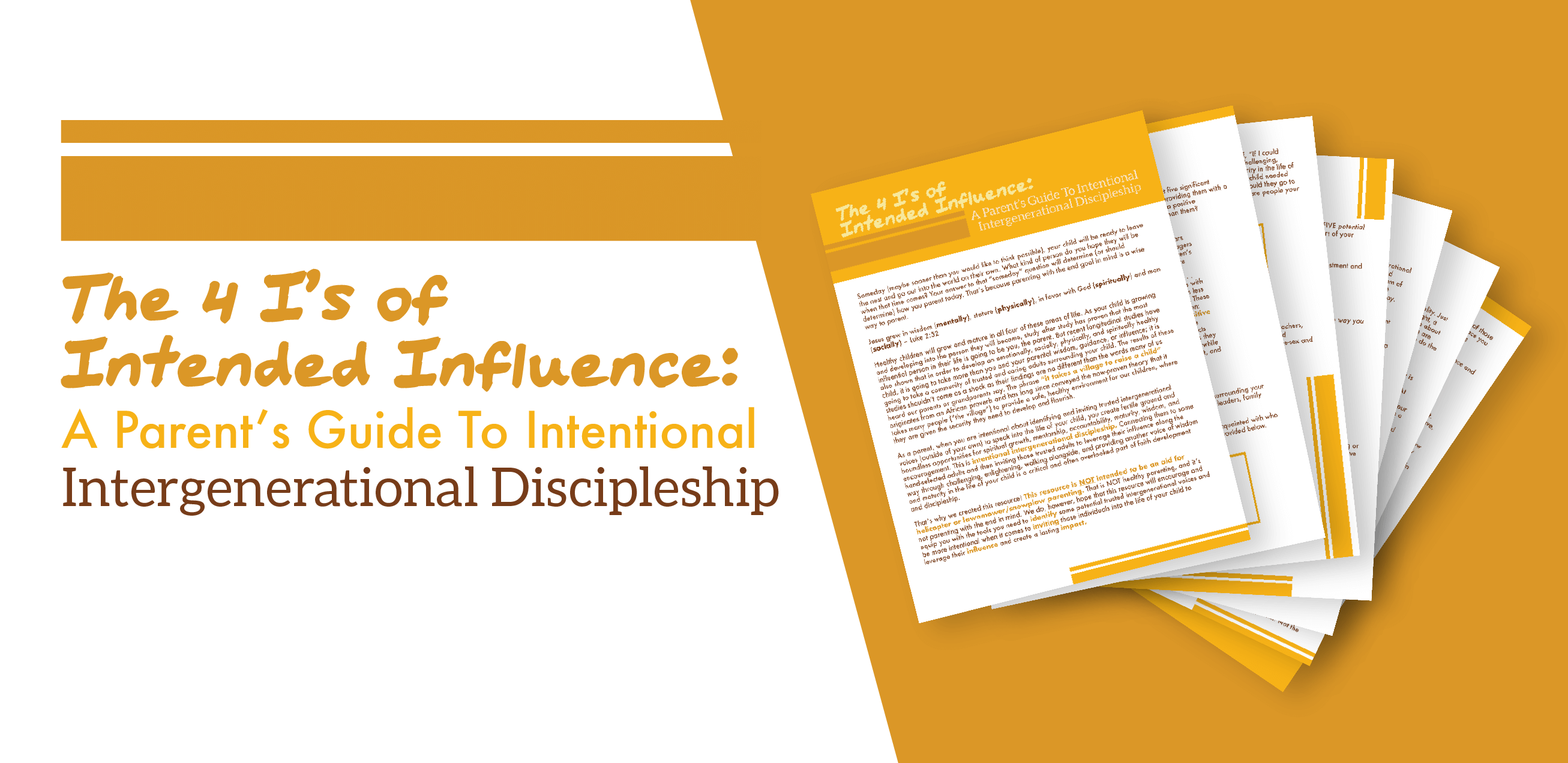
When parents are intentional about identifying and inviting trusted intergenerational voices (outside of their own) to speak into the life of their kids, they create fertile ground and boundless opportunities for spiritual growth, mentorship, accountability, maturity, wisdom, and encouragement. Connecting kids to hand-selected older, wiser adults who are then invited to challenge, enlighten, walk alongside, and provide another voice of wisdom and maturity is a critical and often overlooked part of faith development and discipleship. That’s why the team at M2P has created this Toolbox Resource entitled The 4 I’s of Intended Influence: A Parent’s Guide To Intentional Intergenerational Discipleship that will encourage and equip parents with the tools they need to identify and invite trusted intergenerational voices to influence and provide a lasting impact in the lives of their kids.

HOW TO USE IT

  • Download The 4 I’s of Intended Influence: A Parent’s Guide To Intentional Intergenerational Discipleship and post it on your website.
  • Email parents a copy of the Toolbox Resource and encourage parents to set aside some time to prayerfully and thoughtfully work through it.
  • Print copies of the Toolbox Resource for parents to grab at church and let them know where they can pick it up.

To view or download, click HERE.

We all know (or we will after this month’s M2P resources) that connecting kids to caring adults who model maturity and healthy faith is a critical part of their spiritual development. If, as children’s ministry leaders or volunteers in these ministries, we can foster intergenerational relationships and create an atmosphere of intergenerational discipleship, the kids in our church will be much more likely to develop a life-long faith that will have a profound and lasting impact on them. This month’s coaching videos encourage you and those who serve on your children’s ministry teams to look at your ministry area through the lens of intergenerational discipleship and take a step (or a few steps) by implementing a few things that will help to facilitate meaningful relationships between kids, youth, and adults. Faith should be lived out in community with one another, and the kids who are a part of our churches need to be a part of the larger community with all generations.

To view, click HERE.

In this month’s Online Parenting Class, we encourage parents to consider the power of intentional intergenerational discipleship and work to surround their kids with trusted people of all ages who can spur them on in faith. Church is a great place for the next generation to be surrounded by, poured into, taught by, and intentionally cultivate relationships with past (and future) generations. For this to happen, parents must be proactive in identifying, inviting, and helping to surround their kids with multiple voices of wisdom, maturity, truth, and influence. This Online Parenting Class Video will provide parents with thoughtful insights, creative ideas, and practical steps they can take to make intergenerational discipleship a fundamental part of their kid’s faith development.

To view, click HERE.

New blog posts coming this month:

  • For Kids’ Ministry Leaders: “One Generation to Another” by Amy Diller
  • For Kids’ Ministry Parents: “Much More than Babysitters” by Amy Diller
  • For Youth Ministry Leaders: “Building a Faith that Lasts through Intergenerational Discipleship” by Karin Sasser
  • For Youth Ministry Parents: “Growing an Enduring Faith through Intergenerational Relationships” by Karin Sasser

To view, click HERE

Intergenerational Discipleship In Children’s Ministry

When it comes to developing the children’s ministry that God has called you to build and glorify Him with, you can approach it in many ways. There are so many elements to include, systems to build, curriculum to develop, craft materials to purchase, volunteers to recruit/train, parents to equip, safety measures to implement, and things to pay attention to (like making sure no kids go unaccounted for). We want to develop a ministry that kids love and one that they want to come back to. But the real goal should be building and fostering a culture of discipleship where kids are coming to know, love, and follow Jesus—and one of the best ways to do that is not through crafts, puppets, or fun songs but through intentional intergenerational discipleship.

Intergenerational discipleship simply alludes to creating an environment where older generations can pass on faith to younger generations, and younger generations can encourage older generations to stay strong. Hebrews 10:24 says, “Let us consider how we may spur one another on toward love and good deeds.” Intergenerational discipleship simply helps different generations build faith-filled relationships with one another for the purpose of encouraging each other in their walk with God, and the church is the best place for this to happen.

This month’s coaching video dives into this idea. Our hope is that it will challenge you and those who serve alongside you to take some steps to help parents better understand the importance of this concept of intergenerational discipleship in children’s ministry while you and your team work to create a healthy ministry culture that intentionally fosters and celebrates intergenerational discipleship. This is an important part of children’s ministry to pay attention to, so take some time to think about it, pray about it, talk it over with your team, and determine what you can do to take some steps in this area.

Click the image above to watch the video or click HERE!

The 4 I’s of Intended Influence: A Parent’s Guide To Intentional Intergenerational Discipleship

Someday (maybe sooner than you would like to think possible), your child will be ready to leave the nest and go out into the world on their own. What kind of person do you hope they will be when that time comes? Your answer to that “someday” question will determine (or should determine) how you parent today. That’s because parenting with the end goal in mind is a wise way to parent.

Jesus grew in wisdom (mentally), stature (physically), in favor with God (spiritually) and man (socially) – Luke 2:52

Healthy children will grow and mature in all four of these areas of life. As your child is growing and developing into the person they will become, study after study has proven that the most influential person in their life is going to be you, the parent. But recent longitudinal studies have also shown that in order to develop an emotionally, socially, physically, and spiritually healthy child, it is going to take more than you and your parental wisdom, guidance, or influence; it is going to take a community of trusted and caring adults surrounding your child. The results of these studies shouldn’t come as a shock as their findings are no different than the words many of us heard our parents or grandparents say. The phrase “it takes a village to raise a child” originates from an African proverb and has long since conveyed the now-proven theory that it takes many people (“the village”) to provide a safe, healthy environment for our children, where they are given the security they need to develop and flourish.

As a parent, when you are intentional about identifying and inviting trusted intergenerational voices (outside of your own) to speak into the life of your child, you create fertile ground and boundless opportunities for spiritual growth, mentorship, accountability, maturity, wisdom, and encouragement. This is intentional intergenerational discipleship. Connecting them to some hand-selected adults and then inviting those trusted adults to leverage their influence along the way through challenging, enlightening, walking alongside, and providing another voice of wisdom and maturity in the life of your child is a critical and often overlooked part of faith development and discipleship.

That’s why we created this resource! This resource is NOT intended to be an aid for helicopter or lawnmower/snowplow parenting. That is NOT healthy parenting, and it’s not parenting with the end in mind. We do, however, hope that this resource will encourage and equip you with the tools you need to identify some potential trusted intergenerational voices and be more intentional when it comes to inviting those individuals into the life of your child to leverage their influence and create a lasting impact.

IDENTIFY

Did you know that as your child is growing and developing, they need at least five significant adults in their life who are consistently encouraging them, challenging them, providing them with a positive same-sex role model, spiritually mentoring them, providing them with a positive opposite-sex role model, loyal to them, different than them, and older/wiser than them?

The Search Institute is an organization that has spent over 70 years interviewing and tracking tens of thousands of children and teenagers to better understand the importance of relationships across children’s development. The Institute’s findings show that when children have strong relationships with caring adults, they are more likely to be engaged at school and more motivated to succeed academically. . . One study found that adolescents who have stronger relationships with non-family adults have higher levels of positive support, engage in less risky behavior, and have increased levels of overall well-being. . . These findings led the Search Institute to a simple yet profound conclusion: “Nothing has more impact in the life of a child than positive relationships” . . . But what exactly is a caring relationship? The report found that meaningful relationships share FIVE critical aspects that help children and teenagers thrive: 1. Adults showing students they care about them, 2. Challenging them to become their best selves while providing ongoing support, 3. Sharing power and showing respect, and 4. Expanding their sense of possibilities and opportunities.

(Source: https://blog.searchinstitute.org/new-research-report)

Pause for a few moments to consider the life-changing potential of intentionally surrounding your child with FIVE trusted intergenerational voices (coaches, teachers, small group leaders, family members, neighbors, friends, people in your church, etc.).

Next, take some time to brainstorm all the individuals you already know or are acquainted with who could meet the FIVE critical aspects mentioned above. List them all in the space provided below.

Now, take some time to prayerfully consider this list you’ve made and ask yourself, “If I could hand-select FIVE of these trusted adults listed to leverage their influence through challenging, enlightening, walking alongside, and providing another voice of wisdom and maturity in the life of my child, which FIVE would I pick?” Another way to think about it is asking, “If my child needed someone other than me to talk to, share something with, or get advice from, who could they go to that shares our family’s beliefs and values?”  It’s always helpful if these individuals are people your child is already listening to or wants to hear from. List them below.

Look back at your FIVE and make sure that your list of potential influence and impact is intergenerational and has trusted individuals from a variety of backgrounds (coaches, teachers, small group leaders, family members, neighbors, friends, people in your church, etc.) and highlights the different areas of influence/impact (encourager, challenger, a positive same-sex and opposite-sex role model, spiritual mentor, loyal, different than them, older/wiser).

INVITE

Once you have identified (after some time of prayer and consideration) your list of FIVE potential trusted intergenerational voices, the next step is to invite those individuals to be a part of your child’s life. This can be quite simple.

Facilitating this connection doesn’t need to be difficult or formal. It can be as easy as:

  • Writing the individual a note acknowledging and thanking them for their current investment and influence on your child.
  • Inviting them to coffee with you and your spouse.
  • Volunteering on your child’s team or team’s support network.
  • Scheduling a time to meet with them.
  • Inviting them to join your family for dinner.

Take the FIVE potential trusted intergenerational voices from your list and write down one way you can facilitate a connection through a personal invitation.

Inviting potential trusted intergenerational voices to be a part of your child’s life can be intimidating or awkward for some, but keep in mind that “Nothing has more impact in the life of a child than positive relationships,” and therefore, the work (or potential awkwardness) of intentional intergenerational discipleship is worth it for your child.

INFLUENCE

Influence requires opportunity and consistency. If you want to be intentional with intergenerational discipleship, then you have to help facilitate and nurture it. Creating a list of potential trusted intergenerational voices to be a part of your child’s life and even inviting them into the rhythm of your family is only part of it. Intentional intergenerational discipleship requires you to see the opportunities, provide the means for consistency, and give some encouragement along the way. Take a few moments to honestly answer the questions below:

  • Do you see opportunities at your church to have your child spend time with people of different generations? If so, what are they? Are you committed to getting them there consistently?
  • Are there any older family members who are living a life of faith that you could ask to pour into your child? How might you facilitate opportunity and consistency with these interactions and conversations?
  • Are you praying consistently and specifically for your child as you attempt to put them in situations where intergenerational discipleship can become a normal part of their life?
  • Are you working in active partnership with the trusted intergenerational voices who have said yes to being a part of your child’s life (sharing child-related schedules, concerns, celebrations, struggles, etc.)?
  • Are you actively encouraging the trusted intergenerational voices who have said yes to being a part of your child’s life (thank you notes, small gifts, kind words, volunteering, etc.)?

IMPACT

Impact, especially a lasting impact, takes time, regularity, dedication, and great intentionality. Just as there are no world-renowned athletes, musicians, or scholars who were created overnight, a deep and lasting impact on the life of a child is no overnight sensation. But if you truly care about being more intentional when it comes to your child and intergenerational discipleship, there are some things that you can do as a parent to have a lasting impact and partner with others to do the same in the life of your child:

  • Keep Jesus as your identity and put Him first in your own life.
    • “Therefore, if anyone is in Christ, the new creation has come: The old has gone, the new is here!” – 2Corinthians 5:17
    • Who am I? What is my identity? Where are my meaning and purpose in this life found? At some point, every parent (every individual, for that matter) asks these questions. And the way you answer those questions will determine how you speak to, act toward, and lead your children. This is why it’s crucial for you to understand that your identity as a person and as a parent is not found in your past, your failures, your current circumstances, or even in who your children are/what they are doing. Your identity and your worth are found in Christ and in Him alone.
    • Do you know where your identity rests? Are you putting Him first?
  • Pray
    • “And pray in the Spirit on all occasions with all kinds of prayers and requests. With this in mind, be alert and always keep on praying for all the Lord’s people.”– Ephesians 6:18
    • In parenting, it’s always helpful to remember two things: 1) You may be their parent, but the Lord is their Creator, and He actually loves your child more than you do 2) Your power is limited, but His power is limitless. There is nothing the Lord cannot do. He is sovereign over all. God is not bound by time, space, or your child’s (or your) mistakes. So, why would you not go to the Creator to get guidance and wisdom for dealing with the created?
    • Pray: Lord, please help me as a parent to guide my child in your ways and love them in the unconditional way that you love me. Give me the wisdom, patience, mercy, grace, and humility that only You can give. Help me, Father, to see my child through your eyes. Help me see clearly so that I can best navigate the daily chaos, responsibilities, problems, and joys that come with parenting. Would You surround my child with many trustworthy, caring adults who know, love, and seek to honor You—and who are willing to leverage their influence along the way through challenging, enlightening, encouraging, walking alongside, and providing another voice of wisdom and maturity in the life of my child?
  • Demonstrate Godly character in your home.
    • “[Jesus] answered, ‘Love the Lord your God with all your heart and with all your soul and with all your strength and with all your mind’; and, ‘Love your neighbor as yourself.’”– Luke 10:27
    • In your child’s life, you are the instrument that God uses to communicate and teach the most important thing that your child could ever know: the character, the love, the grace, and the plan of God in their life. It is the essential task that is assigned to you as the parent. Not the church. Not the government. Not the school. Not even the village. Every single one of those things is designed to help and support you, but none of those were designed to replace you. You were chosen by the Creator for this task. You were chosen (hand-selected) by the Creator of the universe to lead your child spiritually.

(source: adapted from https://crossroadsabc.com/article/6-biblical-truths-every-parent-needs-to-know/)

  • Do you demonstrate Godly character in your home? Do you demonstrate the importance and significance of having trusted intergenerational voices speaking into your own life?
  • Practice what you preach by showing grace, mercy, humility, and love.
    • “Do nothing from rivalry or conceit, but in humility count others more significant than yourselves. Let each of you look not only to his own interests, but also to the interests of others.”– Philippians 2:3-4

God doesn’t expect you to be a perfect parent. He knows full well that you are not perfect.  What God wants from you is a willingness to step up and lead your child with what you have, driven by grace, mercy, humility, and love. God’s greatest gift to you as a parent, in His Grace, is Himself. He knows how hard your task is. He knows that it drives you past your ability. He knows that, more often than not, you have no clue what to say, what to do, or how to respond. He knows there are times when your anger gets the best of you. He knows every struggle you have as a parent. And He knows that the only thing in all the world that could help you would be Himself. See, the only thing that makes parenting even remotely possible in light of this truth is that God is with you. God is with you—even when it’s hard, when you are confused, when you feel like a failure, and when you’re angry/frustrated/heartbroken. In all these things, you can show His grace, mercy, humility, and love because you are not alone.

(source: adapted from https://crossroadsabc.com/article/6-biblical-truths-every-parent-needs-to-know/)

  • Are you encouraging other kids in your church or community by being one of their FIVE as they grow in their faith? If not, what are some ways that you can get involved to help another child or teenager?


HERE’S A PREVIEW OF THE RESOURCE:
Building Faith And Moving The Needle Through Intergenerational Discipleship

EMAIL 1

Copy/ Paste this email into a browser and send it to parents.

Subject Line: Building Intergenerational Discipleship into Your Family

Dear Parents,

When it comes to passing on faith to your children, what’s your strategy? Obviously, you’re working to have a growing and vibrant faith yourself. You want to have your child involved in a church where they can learn the stories of God and develop a solid foundation. You may not know this, but you also need to be highly intentional when it comes to connecting your kids to older generations who will model faith and encourage your kids as they grow. You need intergenerational discipleship!

This month, we are going to provide you with some resources that we hope will paint a picture for you of what healthy intergenerational discipleship could look like for you and your family. Our Online Parenting Class Video and Toolbox Resource entitled The 4 I’s of Intended Influence: A Parent’s Guide To Intentional Intergenerational Discipleship will help you better understand the importance of intergenerational discipleship and give you some practical steps to take.

To watch this month’s Online Parenting Class video, click the link below.

[ INSERT LINK TO ONLINE PARENTING CLASS VIDEO ]

Cheering you on!

[INSERT LEADER’S SIGNATURE HERE]


EMAIL 2

Copy/ Paste this email into a browser and send it to parents.

Subject Line: Moving the Needle of Faith Through Intergenerational Discipleship

Dear Parents,

As we continue to seek to help you lead your kids spiritually, we have a thought for you. One of the most important things you can do as a parent is connect your kids to significant, older adults who will pour into them spiritually. Sure, you want your kids to enjoy coming to church and participating in all the events. But the thing that will really move the needle when it comes to them growing in their faith is helping them develop relationships with adults in your church who will spur them on in their faith. We call this intergenerational discipleship.

This month’s resources, like our Online Parenting Class Video and Toolbox Resource, entitled The 4 I’s of Intended Influence: A Parent’s Guide To Intentional Intergenerational Discipleship, will help you better understand the importance of intergenerational discipleship and take some steps into it.  Also, check out this month’s blog article that will offer you some Scripture, encouragement, and some practical ideas on learning how grandparents can be so much more than babysitters in the life of your child. And if you haven’t watched this month’s encouraging Online Parenting Class video, you still have time. To read the blog article or watch the video, click on the links below.

[ INSERT LINK TO M2P PARENTING BLOG ARTICLE ]

[ INSERT LINK TO M2P ONLINE PARENTING CLASS VIDEO ]

We are in this together! Let us know if there is ever anything we can do for you or your family.

Praying for you as you lead at home,

[INSERT LEADER’S SIGNATURE HERE]


M2P August KIDS Parent Video Script

As parents of kids, we kind of have a lot going on.

When it comes to raising our kids spiritually, we need to acknowledge a few things. First, we need to embrace the fact that we are the primary spiritual leaders for our kids. They look to us to teach them about faith and model what it means to have a relationship with God. If we want for our kids to grow into disciples of Jesus, we need to lead the way. The second thing we need to acknowledge is the fact that we need help. We need help to better understand our kids, we need help when it comes to certain issues, and we need other adults saying the same things we are saying so our kids hear about a relationship with God from people who are not us. What we need is an intergenerational cloud of witnesses helping our kids grow in their faith.

Today, I want for you to think about the idea of intergenerational discipleship. Now, intergenerational discipleship means exactly what it says. It’s discipleship that happens in the midst of all the generations together. We should want for our kids to be in an environment where they have the opportunity to meet, build relationships with, and learn from people of all ages. In church, this can sometimes naturally happen with Sunday school teachers or small group leaders but imagine what would happen if we, as their parents, took it further.

Years ago, I heard about a reverse ratio. Typically, when you assemble a group of kids for a class or a group or a field trip, there needs to be a ratio of one adult for every 6/8/10 kids. You have to determine what the best number is. Well, the reverse ratio says this. As kids are growing up, there needs to be five adults surrounding every kid, pouring into them, teaching them, and encouraging them in their faith. And I would argue that a few of their five need to be from an older, more seasoned generation. Many of you have our parents who fit this category, and that’s great. If your parents are followers of Jesus and want to be a part of discipling your kids, lean into that for sure. But some of our kids don’t have grandparents who want to pour into them spiritually, so we have to find that influence elsewhere, and hopefully, that’s in your church.

As a parent, here are a few things you can do. First, make sure your kids are as involved in church as much as possible. As I mentioned, Sunday school, small groups, and “big church” are all great places for your kids to rub shoulders with people in older generations. Get to know the adults who are leading your kids and foster those relationships. What if you invited someone who is leading your child over for dinner one night or out to lunch with your family after church? You have the opportunity to bring people closer to your kids as you seek help in discipling them.

Secondly, look for opportunities to surround your kids with new, again maybe older voices who can encourage them and model what having a real faith looks like. My guess is that there are people in your church who might not teach or volunteer every week, but they can have a presence in your child’s life that will make a real difference. It’s your job to foster these kinds of relationships so that your child is in an environment where intergenerational discipleship happens.

And finally, I would encourage you to be involved in the discipleship of other kids in your church. This could mean that you become a teacher or a leader. Maybe you volunteer at events or coach a team or something else. Or it could simply mean that you make an effort to meet other families in your church and pay attention to the kids, encouraging them along the way. You can play a role in the discipleship of someone else’s kids. You could be a part of some kids 5.

I hope that your kids are going to be a part of the kids’ ministry at your church, where they are surrounded by other kids, they can build friendships, and they can be led by a least one caring adult. But don’t miss the power of a bigger picture of intergenerational discipleship. Do whatever you can to surround your kids with cool, young, hip leaders who your kids will fall in love with, but also surround them with older, more seasoned adults who can share a depth of faith that will have a tremendous impact on your child.

7.1.23

Your July Resources Are Here!

If there’s one thing that we all know as children’s ministry leaders and parents of kids, it’s the fact that they are growing up in a world that is VERY different from the world that any of us grew up in. The struggles of life are not only different, but they are also hitting them earlier, faster, from more angles, and with greater intensity. Whether it’s friends, social media, the constant barrage of sensational news from around the world, global catastrophes, mental health crises, the pressure of getting good grades, fitting in, the pressure to perform, or emotional/financial stress at home, there is plenty to navigate, no matter their age. As our children try to wrap their young minds around these struggles and attempt to formulate their emotional responses to them, they often get bogged down or confused concerning how to process or deal with their own thoughts and emotions. Much of this struggle is leading them to feel a sense of anxiety around…well, a lot of things in their life. The stress and anxiety they feel often can lead them to very unhealthy places mentally and emotionally. These struggles play into their spiritual life, and that’s why we, as adults, have to pay attention, lean into what is happening to our kids, and respond in ways that are healthy and helpful.

This month, your team at M2P is providing you with resources that are aimed at helping parents gain a better understanding of what their kids are going through and equipping them with some practical tools to help their families along the way.

Don’t forget to check out the Blog Articles and  Coaching Video designed for you and your adult volunteers, the Online Parenting Class Video and Toolbox Item entitled 10 Ideas To Help Your Child Navigate & Cope With Anxiety created for parents, and listen to the latest episode of the M2P Podcast with a special guest who just wrote an excellent book on anxiety, Brock Morgan. These resources are designed to give parents some insight and encouragement as they seek to lean in and lead their kids away from an anxious life and hopefully guide them to a life of peace.

Remember that we are here to serve you and to help you serve parents, so let us know if there is ever anything we can do for you or your children’s ministry.

Do not be anxious about anything, but in every situation, by prayer and petition, with thanksgiving, present your requests to God. And the peace of God, which transcends all understanding, will guard your hearts and your minds in Christ Jesus.” – Philippians 4:6-7

The M2P Team


This month’s Toolbox Resource targets an issue that so many families are dealing with on a regular basis. Anxiety among our kids is escalating at an unprecedented rate. Everyone who cares about their own child or young people, in general, is concerned about the staggering rise in childhood and teenage anxiety. Parents are often especially at a loss when it comes to knowing where to begin with helping their kids navigate these dicey waters. The 10 Ideas To Help Your Child Navigate & Cope With Anxiety resource will provide parents with some practical steps to take as they seek to wade in, lean in, and begin to guide their children in a healthy direction.

HOW TO USE IT

  • Download the 10 Ideas To Help Your Child Navigate & Cope With Anxiety resource and post it on your website or email parents a copy of the resources.
  • Encourage parents to take some time to review it and use one or more of these ideas with their kids.
  • Print copies of the resources for parents to grab at church and let them know where they can pick it up.

To view or download, click HERE.

This month’s coaching videos were created to help us, as children’s ministry leaders and volunteers, make sure that we stay aware of what is happening when it comes to kids, parents, and anxiety. As children’s ministry leaders and volunteers, it may seem overwhelming and like you don’t know where to begin, but in reality, there are lots of things that we can do to help support families if we pay attention to the struggles they are facing. It’s sometimes easy to get sucked into the vortex of our weekly events, programming, and other responsibilities, but the real ministry happens when we take the time to help people where they are hurting and in need. And we all know that anxiety is leading kids, and parents into a world of confusion, doubt, and hurt. Take some time to watch the videos and pray through how you can practically help the kids and parents in your care deal with the anxiety they feel.

To view, click HERE.

As kids today are struggling with anxiety at an alarming and unprecedented rate, parents often are at a loss for what to do or how to help. Some parents respond by defaulting to engaging their kids with old-school methods that were used on them. Some parents respond by sticking their heads in the sand, hoping that if they can somehow simply ignore what is happening in their child, the storm will soon pass, and things will go back to normal. Some parents respond by becoming anxious themselves or by throwing up their hands from being overwhelmed or exhausted. None of these is a great, healthy, or helpful response. That is why this month’s Online Parenting Classes were designed to encourage parents to lean in, keep their heads out of the sand, and not give up, but instead stay in the fight when it comes to helping their kids navigate their anxiety. Anxiety in kids doesn’t appear to be going away anytime soon, and we, as children’s ministry leaders, have a unique opportunity to help lead, encourage, and equip parents as they seek to help their kids navigate anxiety.

To view, click HERE.

New blog posts coming this month:

  • For Kids’ Ministry Leaders: “Childhood Anxiety: Practical Ways to Support Families” by Amy Diller
  • For Kids’ Ministry Parents: “Hope for the Anxious Child: Parenting with Empathy and Wisdom” by Amy Diller
  • For Youth Ministry Leaders: “Leading Families Away from Anxiety” by Karin Sasser
  • For Youth Ministry Parents: “Promoting Peace in the Lives of Our Teens” by Karin Sasser

To view, click HERE

Ministering to Kids & Parents in an Anxious World

There is no doubt that one of the most common issues we are dealing with as children’s ministry leaders and volunteers these days is the fact that our kids are under more and more stress and are experiencing real anxiety every day. This anxiety can be paralyzing to them and can lead them to unhealthy thoughts and actions that spiral them into a difficult place. Parents are often either oblivious about what is really happening with their kids or at a loss when it comes to how to help their kids and lead them in a positive, faith-filled direction. As children’s ministry leaders and volunteers, we are uniquely positioned to speak both to the kids and to their parents as we seek to help.

There are lots of things we can do as we are on this journey with families. If we start by taking time to talk about the issue (publicly and privately) and acknowledge what is going on, we open the door for real conversations that can have a real impact. We can spend time in prayer for kids and parents as they navigate the emotions they feel. We can also educate ourselves on the common signs and symptoms of anxiety so we can be aware when a family is in the midst of this struggle.

This month, we want to encourage you and your team to be intentional about engaging in this difficult topic by listening to the felt needs of the families, stepping into critical conversations with kids and parents, and offering parents practical tools that can give them confidence as they try to help their kids navigate the anxiety they feel. We have provided you with a few tangible things, like this month’s Toolbox Resource entitled 10 Ideas To Help Your Child Navigate & Cope With Anxiety, that you can offer to parents as they wade through this ever-growing issue and the Online Parenting Class that hits the issue head-on and has some ideas about how you can leverage your role to help families.

Click the image above to watch the video or click HERE!

10 Ideas to Help Your Child Navigate & Cope With Anxiety

Parents,

This month, we tackle an issue that is becoming more and more prevalent in our society: childhood anxiety. As parents, we know that the world is exerting so much pressure on our kids, and they often feel levels of stress and anxiety that their little minds and bodies are not equipped to handle. We need to pay close attention to what is happening to our kids and do whatever we can to help them land in a healthy place as they grow and develop. If we can pay attention, learn what to look for, and lean in when it comes to guiding our kids through the chaos of the world, they will have a much better chance of making it through their childhood years with a faith that is real and develop a life of peace. This month’s resource, entitled 10 Ideas To Help Your Child Navigate & Cope With Anxiety, will give you some things to think about and some ideas to implement as you seek to lead your kids and help them navigate the stresses of the world and the anxiety they feel.

10 Ideas to Help Your Child Navigate & Cope With Anxiety

  1. Offer Empathy – When your child is anxious, start by expressing empathy which lets them know they are safe and secure in your love. Consistently leading with empathy will also help your child see a representation of the Lord’s love for them through you.
  2. Validate Their Feelings – It’s important for children to feel heard and understood. Your child’s emotions (and fears) are very real to them. Tell him or her that what they’re feeling is okay.
  3. Pray – Pray FOR and WITH your child regularly. Show them that talking with the Lord about our anxieties and expecting Him to answer is very important. Teach him or her to know how to pray by providing simple words to ask for the Lord’s help. “Humble yourselves, therefore, under the mighty hand of God so that at the proper time he may exalt you, casting all your anxieties on Him, because He cares for you.” – 1 Peter 5:6-7
  4. Memorize Scripture – God’s Word is our source of help and healing. Find Bible verses about the Lord’s peace, love, and protection, like Philippians 4:7 or Psalm 36:7. Memorize the verses with your child. Adding motions for a younger child helps to make the words stick.
  5. Journaling – For some kids, drawing or writing about their feelings can be therapeutic. Provide your child with a special journal for them to use any time they want to express their thoughts and emotions when they are anxious, worried, or fearful.
  6. Give Them Words – Children need the vocabulary to talk about anxiety. Talk about words they can use and know what they mean. Visual representations are very helpful for children, so consider creating or purchasing a chart with faces that show what each feeling might look like.
  7. Physical Health – Kids’ bodies can become depleted when experiencing high levels of anxiety. There is a lot of energy that is already being spent by their bodies on their physical and brain growth. Be sure to continue or adopt a healthy diet to provide the nutrients your child needs. Encourage physical activity by joining them.
  8. Breathe – In high-anxiety situations, shallow breathing often occurs. Help your child relax by directing them to take deep breaths with you. Have your child put a hand on their chest and one on their belly to feel them fill up with air, and then exhale slowly until your child is more calm.
  9. Use the Senses – Engaging one of your child’s five senses can also have a calming effect. Seeing, feeling, hearing, tasting, and touching are ways to help your child break out of the worry cycle by focusing on something else. The more senses engaged, the better.
  10. Seek Professional Help – If your child’s daily life is negatively affected and you are concerned that the anxiety is more than just typical childhood experiences, don’t hesitate to reach out for professional help. Get a medical examination for physical symptoms and find a trusted Christian therapist by asking church and school leaders for recommendations. There is no shame for the child or the parent in asking for and seeking help.


HERE’S A PREVIEW OF THE RESOURCE:

Helping Your Child Navigate And Cope With Anxiety

EMAIL 1

Copy/ Paste this email into a browser and send it to parents.

Subject Line: Navigating Childhood Anxiety

Dear Parents,

When you think about your kids and all they have to deal with in today’s world, there is an issue that continues to be on the rise. Sadly, anxiety is something that is increasingly creeping into the lives of our kids, and it’s something that is starting earlier and earlier in life. Most kids today deal with some sort of anxiety, and, as parents, you have the unique opportunity to pay close attention to what is happening with your kids and help them learn to navigate these very real feelings in healthy ways. This month, we want to help you think about what you can do to be proactive in your child’s struggle with stressors, fears, and anxious thoughts. The Online Parenting Class and Toolbox Resource entitled 10 Ideas To Help Your Child Navigate & Cope With Anxiety will provide you with some suggestions for how you can engage with your child as they encounter these feelings. These resources will place some practical tools at your fingertips that you can use to lean into conversations with your child that will help them grow as they learn how to navigate their thoughts, feelings, and emotions.

To watch this month’s Online Parenting Class video, click the link below.

[ INSERT LINK TO M2P ONLINE PARENTING CLASS VIDEO ]

You can do this! We are always here for you if you need us.

Do not be anxious about anything, but in every situation, by prayer and petition, with thanksgiving, present your requests to God. And the peace of God, which transcends all understanding, will guard your hearts and your minds in Christ Jesus.” – Philippians 4:6-7

Cheering you on,

[ INSERT LEADER’S SIGNATURE HERE ]


EMAIL 2

Copy/ Paste this email into a browser and send it to parents.

Subject Line: Helping Your Kids Cope with Anxiety

Dear Parents,

When it comes to helping your children navigate stress and anxiety, what’s your strategy? In today’s world, kids are being forced to grow up and deal with thoughts and issues that their developing brains aren’t equipped to process. Much of their mental and emotional struggles lead them to experience real anxiety that they have no idea how to cope with. As their parent, you are best positioned to help them navigate these thoughts and emotions, and we want to help. This month’s resources are designed to give you helpful and practical ideas/tools to lead your child to a healthy place.

Check out this month’s blog article, “Hope For The Anxious Child: Parenting With Empathy & Wisdom,” and the Toolbox Resource entitled 10 Ideas To Help Your Child Navigate & Cope With Anxiety for some much-needed encouragement and some practical ideas as to what you can do as their parent to help your child learn how to move through life and deal with the anxieties they will no doubt face in a healthy way.

And if you haven’t watched this month’s encouraging Online Parenting Class Video, you still have time. To read the blog article or watch the video, click on the links below.

[ INSERT LINK TO M2P PARENTING BLOG ARTICLE ]

[ INSERT LINK TO M2P ONLINE PARENTING CLASS VIDEO ]

We are in this together! Let us know if there is ever anything we can do for you or your family.

Do not be anxious about anything, but in every situation, by prayer and petition, with thanksgiving, present your requests to God. And the peace of God, which transcends all understanding, will guard your hearts and your minds in Christ Jesus.” – Philippians 4:6-7

Praying for you as you lead at home,

[INSERT LEADER’S SIGNATURE HERE]


M2P July KIDS Parent Video Script

When my children were little, I remember them being afraid of a variety of things from time to time. Fear of the dark, loud storms, and new situations, to name a few. My oldest slept with her light on for a time because she said she liked it better, which we knew was because the dark was scary for her. My youngest daughter was scared at bedtime because she thought she was going to have bad dreams, so we prayed with her each night and added a little p.s. that her dreams would be filled with puppies, kitties, cupcakes, and sprinkles.

Children typically experience fears at different points growing up, especially during periods of change like going to school for the first time, moving to a new house, meeting new people, or unfamiliar situations. These things are normal, and the anxious behavior kids display typically goes away after a while. It doesn’t downplay children’s concerns at all, and parents’ help to alleviate these fears is vital.

Anxiety is defined as a condition characterized by excessive apprehensiveness about real or perceived threats, typically leading to avoidance behaviors and often to physical symptoms. We know that based on current statistics and studies, anxiety among younger children is on the rise. As parents, we need to be aware of common signs and symptoms children might display and have tools to help them.

Anxiety in kids can present differently than in teens or adults. Chronic tummy aches, headaches, irritability, trouble sleeping, not wanting to be away from parents, and unusual clinginess can all indicate the presence of anxiety. Irrational fears or extreme worry can also be present, making a child feel anxious.

So, what can a parent do if a child displays signs of anxiety? First of all, pray for the Lord’s wisdom and discernment. Ask Him to guide and direct you in addressing your child’s needs and to understand what you’re seeing in his or her behavior. Pray with your child, too. Using scripture as you pray is a wonderful way to plant the seeds of God’s Word in the heart of your child. Helping your child memorize verses about the Lord’s peace, love, and protection is a way to equip them with His truth.

An important tool to embrace is to lead with empathy and compassion. Sometimes our response is to jump in and try to fix the problem, telling our child why they don’t need to be afraid. That’s not a bad approach, but it’s not the first thing a parent should do. Instead, meet your child’s fear first with an abundance of love, understanding, and assurance that all will be okay. Childhood fears and worries are very real and can be overwhelming; offering compassion validates a child’s feelings. Empathy calms an anxious heart. When this is your first response, your child will be better able to feel comforted in the safety of your love. It also opens the door for your child to see the love of Jesus expressed through your actions and to know that He is with them in all things.

Finally, it’s important to know when it’s time to seek professional help. If anxiety doesn’t lessen over a reasonable period of time with your guidance, if fears and worries increase in intensity, or if your child presents with constant physical symptoms, it would be a very good idea to reach out for evaluation and assistance. Start with an exam at your pediatrician’s office to be sure physical symptoms are caused by anxiety or if there are underlying conditions causing problems. Ask church leaders for recommendations of therapists who can help you and your child deal with anxieties. It is especially helpful to see someone who specializes in therapy for children if one is available near you.

Be encouraged that there is hope and healing for your child’s troubled mind and heart. There is wisdom available to you from the Lord, from other parents who have walked the path with an anxious child, and from your church leaders. Lavish your child with empathy and compassion, speak words of God’s truth to him or her and seek professional help when needed.