

Author Archives: Les Bradford

11.1.22

Your November Resources Are Here!

This month of M2P is all about getting (and staying) “in the game.” As parents and ministry leaders, we often find ourselves thrown into a game-time scenario in that we feel vastly underprepared to play or that we lack the training or skillset to truly compete. Imagine being a confident, professional field-goal kicker who is suddenly thrown into a football game as an offensive lineman. It doesn’t take long for any confidence you had to begin to fade as you look across at the large dump truck of a man you are now responsible for blocking (or at least slowing down). As your palms start to sweat and the anxiety grows, your thoughts become more focused on your literal survival than on your potential to thrive. I think it’s safe to assume that you’d be much more concerned with the more likely reality of being carried off the field on a stretcher than the potential of being carried off the field on the shoulders of your teammates.

As crazy as that example may sound, is it really that different than the very real feelings of anxiety and hopelessness so many of us feel as parents who are trying to raise children in today’s culture? Or as a children’s ministry leader who’s trying to lead well in the realities of a post-COVID church. The stress, anxiety, and panic of surviving ultimately drown out all thoughts of staying “in the game,” much less thriving there. Parents are truly struggling with making faith and church involvement a top priority in the rhythm of their family. Children’s ministry leaders, who are still feeling the impact of the last few years of being thrown into a new world, are trying to lead in a new normal where families view their church involvement differently. If we’re honest, parents and ministry leaders alike are struggling with “staying in the game” emotionally and spiritually. We just feel like we are being run over by the dump truck of a lineman again and again. We need tools and disciplines that will keep our faith and health strong. We hope this month’s M2P resources help you stay in the game and lead parents and families to stay involved.

For more on this topic, don’t forget to check out the blog articles, coaching video, online parenting class video, toolbox item, and the latest episode of the M2P Podcast. Remember that we are here to serve you and to help you serve parents, so let us know if there is ever anything we can do for you or your ministry.

Blessings, 

The M2P Team

WHAT IS IT?

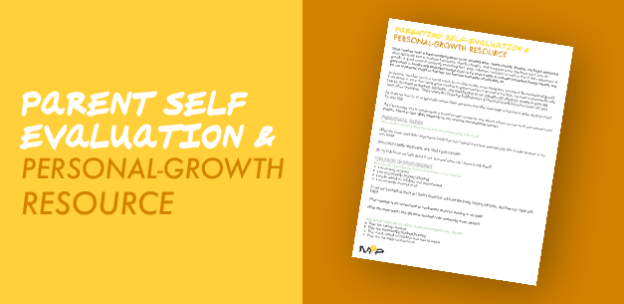
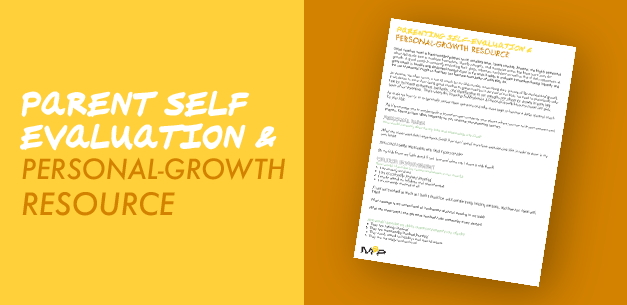
This Parenting Self-Evaluation & Personal-Growth Resource is designed to help parents take some time to think about how they are parenting and evaluate how “in the game” they are when it comes to their kids’ spiritual growth. This resource works hand in hand with this month’s video, articles, and social media posts and challenges parents to make sure they aren’t just in the stands cheering their kids on, but they are actually “in the game” with their kids.

HOW TO USE IT

  • Download “Parenting Self-Evaluation & Personal-Growth Resource” and post it on your website.
  • Email parents a copy of the resource or a link to it and encourage them to set aside some time to go through the questions.
  • Print copies of the document for parents to grab at church.

To download, click HERE for youth and HERE for kids.

This month we want to encourage you, as a children’s ministry leader, to step more and more into your role as a coach for the parents in your church and community. You’re not just someone who plans and runs programming for kids; you are a spiritual leader who has been given tremendous influence. You have the ability to guide parents and help them step into the role God has called them to play in their kids’ lives, so check out this month’s video that may help you stay “in the game” yourself.

To view, click HERE for youth and HERE for kids.

In this month’s parent video, we encourage parents to intentionally focus on building strong relationships with their kids that will last a lifetime. Our lives and the lives of our kids are often so busy that we, as parents, must be highly intentional about carving out the time to foster healthy relationships and not allow that time to get crowded out. As parents, we need to take building relationships with our kids seriously and make it just as much an intentional part of our parenting strategy as we do guiding, directing, and correcting.

To view, click HERE for youth and HERE for kids.

New blog posts coming this month:

  • Coaching Parents to Lead by Chris Sasser
  • Parents on the Sidelines – Encouraging Them to Lead at Home by Amy Diller
  • The Best Defense Might Be a Good Offense by Chris Sasser
  • Stay Off the Sidelines by Amy Diller

To view, click HERE

Get in the Game, and Help Parents Do the Same

This month we want to encourage you, as a children’s ministry leader, to step more and more into your role as a coach for the parents in your church and community. You’re not just someone who plans and runs programming for kids; you are a spiritual leader who has been given tremendous influence. You have the ability to guide parents and help them step into the role God has called them to play in their kids’ lives, so check out this month’s video that may help you stay “in the game” yourself.

Click the image above to watch the video or click HERE!

Parenting Self-Evaluation & Personal-Growth Resource

Good coaches want to have excellent players on an excellent team. Great coaches, however, are highly intentional about taking the time to evaluate themselves, identify strengths, and recognize areas that have more room for growth. A good coach is constantly evaluating their plays, schemes, and plans as well as that of their opponents. A great coach is humble and dedicated enough to put in the work it takes to evaluate themselves through honesty and the use of personal insight so that they can become even better at what they do.

As parents, we often act as a sort of coach for our kids as they move along their journey of life and spiritual growth. If we desire to move from being good coaches to great coaches in the lives of our kids, we need to periodically take time for an honest assessment, evaluation, and identification of our strengths and places for growth in some key areas of our parenting.  That’s where this Parenting Self-Evaluation & Personal-Growth Resource comes into play.

Set aside an hour or so to genuinely answer these questions and take some steps to become a better spiritual coach for your kids.

We’d encourage you to maybe grab a journal or open a note on your phone where you can write your answers and prayers. Return to these ideas frequently as you continue your parenting journey.

Personal Faith

How would I currently describe my faith and relationship with God?

What are some ways that I experience God? How can I spend more time experiencing Him in order to grow in my own faith?

How could a better relationship with God impact my life?

Do my kids know my faith story? If not, how and when can I share it with them?

Church Involvement

How would I describe my current involvement in our church?

I am actively involved

I am occasionally Involved (monthly)

I mostly attend on holidays and special events

I am not really involved at all

If I am not involved as much as I think I should be, what are the things holding me back, and how can I deal with them?

What message is my current level of involvement at church sending to my kids?

What are some ways I can get more involved in the community at my church?


How would I describe my child’s current involvement in our church?

They are actively involved

They are occasionally Involved (monthly)

They mostly attend on holidays and special events

They are not really involved at all

If my child is not involved as much as I think they should be, what are the things they say are holding them back, and how can I help them better navigate those things?

What message is my current level of apathy to my kid’s involvement at church sending to them?

What are some ways I can be more proactive when it comes to helping my kid discover community at our church?


Relationships With My Kids

How would I describe my current relationship(s) with my kid(s)?

Do I know …    my kid’s best friends?

my kid’s favorite musical artist?

my kid’s favorite hobbies?

my kid’s biggest aspiration/dream?

my kid’s biggest personal/emotional struggles?

my kid’s biggest joys?

my kid’s biggest fear?

my kid’s biggest questions?

my kid’s faith journey?

who my kid is listening to and being influenced by?

If I don’t know these things, how can I build the relationship in a way where I can regularly have conversations and offer the encouragement they need?

What are some ways that I connect with my kids? How can I lean into these even more in order to strengthen the relationship?

How often do I spend time with my kids with no agenda, just being present and building the relationship?

Daily

A few times a week

Once a week

Twice a month

Monthly

Rarely

What are some ways that I can invest more intentionally in my relationship(s) with my kid(s)?

Prayers

What are some specific, regular things I can pray for my kids or for myself as their spiritual coach?

LINKS:

CLICK HERE TO DOWNLOAD THE RESOURCE

HERE’S A PREVIEW OF THE RESOURCE:


Get In The Game For Your Child. Get In The Game With Your Child.

EMAIL 1

Copy/ Paste this email into a browser and send it to parents.


Subject Line: More Than a Referee

Dear Parents,

As our kids move through the game of life, parents can often feel like a referee. There are fouls to call and boundaries to watch. If we want for our kids to really embrace and grow in their faith, we need to be more than a referee. We need to be “in the game” with them.

This month’s Online Parenting Class video will provide great encouragement for you and some practical tips, ideas, and resources on how to better lead/coach your kid’s spiritual growth journey. To watch the brief video, click the link below.

[ INSERT LINK TO ONLINE PARENTING CLASS VIDEO ]

Thanks for letting us be “in the game” with you as we all seek to help our kids grow in their faith. Please let us know if there is anything we can do for you.

In this alongside you,

[ INSERT LEADER’S SIGNATURE HERE ]

EMAIL 2

Copy/ Paste this email into a browser and send it to parents.

Subject Line: Are You “In the Game?”

Dear Parents,

As parents, it’s often easy to sit in the stands and watch our kids move through life. Sure, we want to cheer them on, but there are times when we need to be more than their biggest fan. We need to be “in the game” with them.

In this month’s blog article, you’ll discover some practical tips on get off the sidelines and get in the game. Take a few minutes to check it out. You’ll be glad you did.

And don’t forget to check out this month’s Online Parenting Class video, where we give you some encouragement, tips, ideas, and resources on how you can do more than cheer your kids on but play in the game with them.

[ INSERT LINK TO M2P PARENTING BLOG ARTICLE ]

[ INSERT LINK TO M2P ONLINE PARENTING CLASS VIDEO ]

Hang in there and keep playing hard! Also, remember that we are always here for you if you need us.

Praying with you and for you, as you lead at home.

[ INSERT LEADER’S SIGNATURE HERE ]

Video Script

Whistle …… That’s a personal foul on Sally for pushing her brother! Oh wow, that’s a technical foul on Billy for biting Sally! That actually might be targeting!

When it comes to family life, do you sometimes feel like a referee? When our kids are small, and our house is busy, we sometimes spend all day long just calling fouls, keeping score, and trying to keep the game under control. The reality is that when we think about the mental, emotional, and spiritual growth and development of our kids, it’s a bigger game to care about, isn’t it? I recently heard a quote that I think applies to what I want to talk about. “Let’s not lose our kids to a world that isn’t playing fair with this generation. What we have to do is GET IN THE GAME!”

I don’t want to reduce the lives of our children to a game, but I think the analogy works. There is a game, and sometimes several games, that they have to play each and every day, and you and I, as parents, have to pay attention to the games that our kids are playing. There’s a game that is happening with their identity where they are trying to figure out who they are and where they belong. They play comparison games with their siblings, and their peers, and with the world. They sometimes play games with their faith. As they grow up, they learn the right things to say, and they can sometimes be involved with church just enough to make it look like they are serious about it all. And the way the world is influencing our kids is not fair! We could call a lot of fouls on that.

In order for our kids to be in the right game of life and faith, I would argue that we, as their parents, have to be so much more than referees; we have to be in the game with them. Now I’m not talking about the helicopter game where we hover and make sure everything is going well. But I do mean that we need to do more than be satisfied with just being in the stands and watching them play, but we need to be playing WITH them. In order for your kids to be “in the game,” you need to be “in the game” too.

We need to be in the game with our own faith. Too many parents send their kids to Sunday school and VBS, and other church events hoping that the church will lead their kids in the right direction. Well, I have to tell you that our kids see through that. If we are hoping that they will develop a real, authentic faith themselves, we have to model what a real, authentic faith looks like and make talking about faith a normal and natural part of life.

We also need to be in the game when it comes to the relationships we are building with our children. We need to go beyond just guiding them and teaching them the things we think they need to know, but we need to intentionally connect with them in order to deepen the relationships that we have together. We have to invest in them and give them time, and because our kids are so busy, we might sometimes need to adapt our schedules to fit into theirs. We also might need to walk away from the games or other things we do on our devices and not be distracted when we interact with our kids.

Finally, I think we need to be in the game with our church. As humans, we are wired for community, and we need to value being involved with the faith community of our church. Again, if we push our children to be involved in church, but we aren’t involved ourselves, in the long run, our actions will speak louder than our words, and they might not value being a part of a faith community.

So, what does it mean for you, as a parent to be “in the game” when it comes to the faith of your kids? Because you know what? You’re #1. You are, You are the #1 spiritual leader in your kids’ lives, so figure out how you can get in the game with them and not just be a spectator in the stands.

10.1.22

Your October Resources Are Here!

This month at M2P, we’re focusing on quite possibly the most important aspect of our lives: relationships. Our relationships are truly at the center of everything we do, and they chart the course for our homes. How can we, as children’s ministry leaders, help the kids and parents who participate in our ministry build and maintain strong relationships in their homes? We all know that strong relationships in life start with a strong relationship with God, so this month we want to provide you with ideas, tools, and resources to help parents think about how to build and deepen the spiritual and relational connections in their families.

For more on this topic, don’t forget to check out the blog articles, coaching video, online parenting class video, toolbox item, and the latest episode of the M2P Podcast. Remember that we are here to serve you and to help you serve parents, so let us know if there is ever anything we can do for you or your ministry.

Blessings, 

The M2P Team
WHAT IS IT?

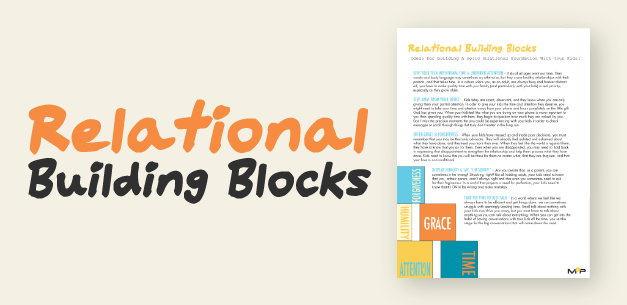
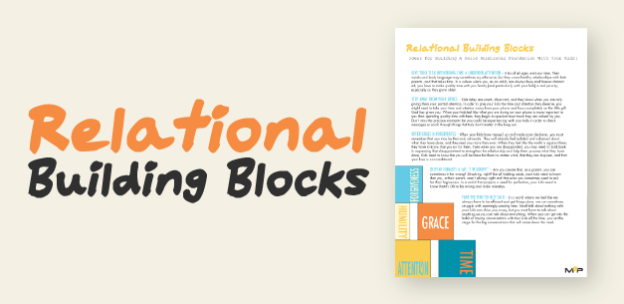
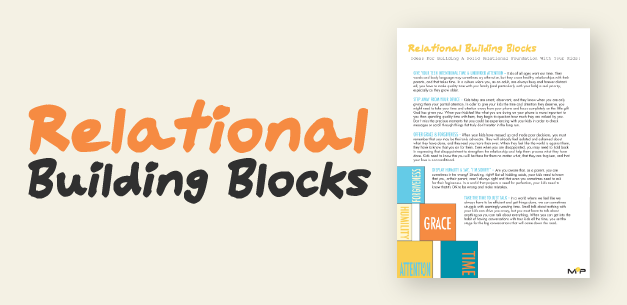
This month’s toolbox item called “Relational Building Blocks” is a downloadable resource that gives parents some practical suggestions for how to strengthen their relationships with their kids. There are small things parents can consistently do that will help build and sustain healthy relationships that will last over time.

HOW TO USE IT

  • Download “Relational Building Blocks” and post it on your website.
  • Email parents a copy of the resource or a link to it and encourage them to take the time to think through how they can implement these simple suggestions.
  • Print copies of “Relational Building Blocks” to have available at church.

To download, click HERE for youth and HERE for kids.

This month we want to help you think through how you can help families develop stronger relationships at home. How can you, as a children’s ministry worker, build a culture and create opportunities that will help parents build the relationships with their children that they will need to sustain them along their journey together? Well, there are some things you can do to set families up for success in this area, and we will share them with you in this month’s video.

To view, click HERE for youth and HERE for kids.

In this month’s parent video, we encourage parents to intentionally focus on building strong relationships with their kids that will last a lifetime. Our lives and the lives of our kids are often so busy that we, as parents, must be highly intentional about carving out the time to foster healthy relationships and not allow that time to get crowded out. As parents, we need to take building relationships with our kids seriously and make it just as much an intentional part of our parenting strategy as we do guiding, directing, and correcting.

To view, click HERE for youth and HERE for kids.

New blog posts coming this month:

  • Relationships Matter by Chris Sasser
  • Training Small Group Leaders and Sunday School Teachers to Honor Parents by Amy Diller
  • Connection Over Content by Chris Sasser
  • Tips for Building Stronger Relationships with Your Kids by Amy Diller

To view, click HERE

Helping Families Build Strong Relationships at Home

This month we want to help you think through how you can help families develop stronger relationships at home. How can you, as a children’s ministry worker, build a culture and create opportunities that will help parents build the relationships with their children that they will need to sustain them along their journey together? Well, there are some things you can do to set families up for success in this area, and we will share them with you in this month’s video.

Click the image above to watch the video or click HERE!

Ideas For Building A Solid Relational Foundation With Your Kids

Give Your Kid Intentional Time & Undivided Attention – Kids of all ages want our time. Their words and body language may sometimes say otherwise, but they crave healthy relationships with their parents, and that takes time. In a culture where you, as an adult, are always busy and forever distracted, you have to make quality time with your family (and particularly with your kids) a real priority, especially as they grow older.

Step Away From Your Device – Kids today are smart, observant, and they know when you are only giving them your partial attention. In order to give your kids the time and attention they deserve, you might need to take your time and attention away from your phone and focus completely on the little gift God has given you. When your kids feel like what you are doing on your phone is more important to you than spending quality time with them, they begin to question how much they are valued by you. Don’t miss the precious moments that you could be experiencing with your kids in order to check messages or scroll through things that truly don’t matter in the long run.

Offer Grace & Forgiveness – When your kids have messed up and made poor decisions, you must remember that you may be their only advocate. They will already feel isolated and ashamed about what they have done, and they need you more than ever. When they feel like the world is against them, they have to know that you are for them. Even when you are disappointed, you may need to hold back in expressing that disappointment to strengthen the relationship and help them process what they have done. Kids need to know that you will be there for them no matter what, that they are forgiven, and that your love is not conditional.

Display Humility & Say, “I’m sorry!” – Are you aware that, as a parent, you are sometimes in the wrong? Shocking, right? But all kidding aside, your kids need to know that you, as their parent, aren’t always right and that even you sometimes need to ask for their forgiveness. In a world that projects a need for perfection, your kids need to know that it’s OK to be wrong and make mistakes.

Take The Time To Just Talk – In a world where we feel like we always have to be efficient and get things done, we can sometimes struggle with seemingly wasting time. Small talk about nothing with your kids can drive you crazy, but you must learn to talk about anything so you can talk about everything. When you can get into the habit of having conversations with tour kids all the time, you set the stage for the big conversations that will come down the road.

LINKS:

CLICK HERE TO DOWNLOAD THE RESOURCE

HERE’S A PREVIEW OF THE RESOURCE:


Building Strong Relationships With Your Child

EMAIL 1

Copy/ Paste this email into a browser and send it to parents.


Subject Line: Building Strong Relationships at Home

Dear Parents,

We all know that relationships are at the center of our lives and that no relationships are more important than those in our own homes. However, building strong relationships with our children can sometimes be tricky to navigate. And, if we are honest, there are times when cultivating thriving relationships with our children can prove to be downright challenging. If you long to build healthy and thriving relationships with your children that will stand up through trials and the test of time, it’s going to require a strong relationship with God, intentionality, and a lot of investment from you as the parent. Building these relationships isn’t always going to be easy, but the ROI will pay rich dividends for you, for your kids, and for your entire family.

With that in mind, we want to provide you with some ideas, tools, resources, and a little needed encouragement to help you navigate building strong, healthy, and thriving relationships with your child.

This month’s Online Parenting Class video will provide you with some encouragement and a few proven tips on building and deepening spiritual and relational connections with your children at home. To watch the brief video, click the link below.

[ INSERT LINK TO ONLINE PARENTING CLASS VIDEO ]

Thank you for allowing us to partner with you as you lead your family. If you have any questions, please don’t hesitate to reach out.

In this alongside you,

[INSERT LEADER’S SIGNATURE HERE]

EMAIL 2

Copy/ Paste this email into a browser and send it to parents.

Subject Line: Practical Tips to Strengthen Your Relationships with Your Kids

Dear Parents,

How strong would you say your relationships are with your kids? Do you wish you knew some things you could do to strengthen those relationships with your child? If you are anything like most parents raising children, it’s a safe bet that your answer to that question is a “Yes!”

In this month’s blog article, you’ll discover some practical tips on building, strengthing, and maintaining your relationships with your kids. Take a few minutes to check it out. You’ll be glad you did.

And if you haven’t watched this month’s Online Parenting Class video, you still have time. Take a few minutes to invest in your family’s long-term relational health today! Click on the links below to read the blog article or watch the video.

[ INSERT LINK TO M2P PARENTING BLOG ARTICLE ]

[ INSERT LINK TO M2P ONLINE PARENTING CLASS VIDEO ]

Thanks again for trusting us to influence your family. It’s an honor.

Praying for you as you lead at home,

[INSERT LEADER’S SIGNATURE HERE]

Video Script

Years ago, I heard a great piece of parenting advice from a mentor of mine. He said this, “One of the goals in parenting is to have a REAL relationship with your kids when they are in their 20s.”

Now, depending on how old your kids are, that may feel like a long way down the road, and you may be thinking, “There’s a lot that happens between now and then.” And that’s kind of the point, there’s a LOT that happens between now and then, and what happens in your relationships with your kids over the next number of years can dictate whether or not you will have a REAL relationship with them in their adult years.

As our kids grow up, one of the things that happen is our relationships can quickly become somewhat mechanical, because there are a lot of things that have to get done. Every day we have to get our kids up, and make sure they’re fed and clothed before they walk out the door. They have to gather all of their stuff and get to school and then after school there might be practice or there’s cleaning up and dinner and homework and events and just a lot of stuff to do! At the end of the night, we all collapse and get up the next day to do it all over again.

In the midst of all the chaos, what gets crowded out … is the relationship. We’re all often in the same space and all trying to move in some direction forward, but building deep, meaningful relationships that will last a lifetime can be hard.

So, as we think about the goal of having a real relationship with our kids when they get older, we have to determine what we can do to along the way to build and strengthen our relationships with one another.

  1. The first thing I would suggest is to give them time, and lots of it. Kids of all ages want our time. Their words and body language may sometimes say otherwise, but they crave healthy relationships with us, and that takes time. In a culture where we are always busy and forever distracted, we have to make quality time with our families (and particularly with our kids) a real priority.

In giving our kids time, we have to remember that they are smart and observant, and they know when time doesn’t equal attention. One night while we were at the table eating dinner, I felt compelled to check something that was buzzing on my phone. My son, using a quote from a TV ad campaign, said, “Dad, device-free dinner?” Simply being in the same physical space doesn’t mean that I am truly present with others in that same space. If I want my kids to believe that I am really there for them, I need to step away from technology and put my full attention on them. If I don’t, they will notice.

As we navigate this principle, we may have to give them time on THEIR time. If you haven’t heard, kids are busy. One day when my daughter got home from soccer practice, she asked me to play a card game with her. I was finishing up something for work, and we were soon to be eating dinner. I had a choice to make. She had the time and was asking me for mine. Thinking about this principle, I walked away from the computer and into a game of Crazy 8s, and I was glad I did.

  1. Along the same lines, take the time to just talk. In a world where we feel like we always have to be efficient and get things done, we can sometimes struggle with seemingly wasting time. Small talk about nothing with our kids can drive us crazy (at least it can me), but we have to learn to talk about anything so we can talk about everything. When we can get into the habit of having conversations with our kids all the time, we set the stage for the big conversations that will come down the road. We have to build a relationship where our kids will share things with us about their emotions, their thoughts, their dreams, their friendships, and their struggles. If talking to mom and/or dad is not a normal part of their lives by the time they get to their teenage years, it may be hard for them to learn to share the details of their lives. Don’t fall into the trap of always trying to solve life’s problems for them. Just be there for them and listen.
  2. And finally, be their biggest fan. You don’t always have to be their coach (formally or informally). You don’t always have to be their teacher, although they do need to respect and listen to you. You certainly don’t need to do what a lot of parents do, become their agent, who is always negotiating for them and pushing them down a certain path. Just be their biggest fan. Cheer for them in sports, in school, in theatre, and in their relationships. Make sure they know, beyond the shadow of a doubt, that you have their back, that you are proud of them, and you will be with them all along the way. If your kids feel like you are FOR them as they navigate their life, if they really believe that you are in it for THEM and you want to help them grow into who God has created THEM to be, your relationship will grow and you’ll have the opportunity to influence them in a far greater way.

Relationships matter, and your relationships with your kids are some of the most important you or they will ever have. Nurture them, invest in them, and give them the time and attention they need. In the long run, you’ll be glad you did.

9.1.22

Your September Resources Are Here!

This month of M2P content is laser-focused on helping parents and children’s ministry leaders better navigate the incredible pressure to perform that permeates our culture. So whether you have a ministry parent trying to lead their kids into a healthy mindset or you’re a children’s ministry leader trying to live into the calling you have received, M2P has got you covered. So dive into this month’s content because we have some incredible insight, tips, tools, and encouragement for you and the parents you serve!

For more on this topic, don’t forget to check out the blog articles, coaching video, online parenting class video, toolbox item, and the latest episode of the M2P Podcast. Remember that we are here to serve you and to help you serve parents, so let us know if there is ever anything we can do for you or your ministry.

Blessings, 

The M2P Team


WHAT IS IT?

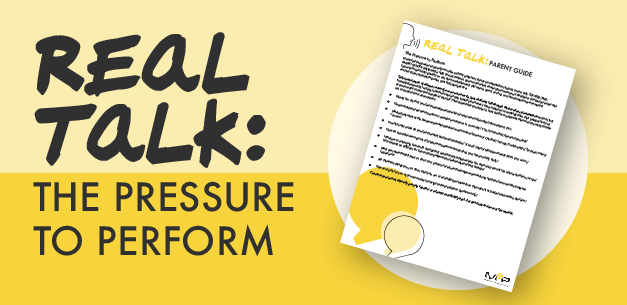
This REAL TALK: PARENT GUIDE is designed to help facilitate a family conversation around the pressure that kids feel to perform in every area of life. Parents can help their kids identify ways to reduce the pressure and step into a more sustainable pace of life and a healthier view of themselves.

HOW TO USE IT

  • Download the REAL TALK: PARENT GUIDE and post it on your website.
  • Email parents a copy of the resource or a link to it and encourage them to take time as a family to have the conversation.
  • Print copies of the REAL TALK: PARENT GUIDE for parents to grab at church.

To download, click HERE for youth and HERE for kids.

This month we encourage you, as a ministry leader, to think about how you navigate the pressure you feel to perform. We all want to be the best ministry leaders we can be, but how clear are we about what success looks like and how much of our identity is wrapped up in what we do, not who God says we are? This month’s coaching video provides you with some practical wisdom and encouragement about setting appropriate boundaries and resting in your identity first and foremost as a child of God.

To view, click HERE for youth and HERE for kids.

In this month’s Online Parenting Class video, we encourage parents to pay attention to the immense pressure their kids are feeling and how this pressure is impacting them in so many ways. There are some practical things a parent can do to reduce the pressure at home and help their kid build a healthier outlook on life.

To view, click HERE for youth and HERE for kids.

New blog posts coming this month:

  • Navigating the Pressure to Perform in Children’s Ministry by Amy Diller
  • Living for An Audience of One by Chris Sasser
  • Helping Children Navigate the Pressure to Perform by Amy Diller
  • Reducing the Pressure by Chris Sasser

To view, click HERE

Reducing the Pressure in Children’s Ministry

This month we encourage you, as a children’s ministry leader, to think about how you navigate the pressure you feel to perform. We all want to be the best children’s ministry leaders we can be, but how clear are we about what success looks like and how much of our identity is wrapped up in what we do, not who God says we are? This month’s coaching video provides you with some practical wisdom and encouragement about setting appropriate boundaries and resting in your identity first and foremost as a child of God.

Click the image above to watch the video or click HERE!